3 Things to Know Before Adding Accenture (ACN) to Your Watchlist
Accenture (ACN) is trading below its own five-year valuation averages, but it isn’t cheap compared with its peers. Here are three things to understand about its acquisitions, backlog, and AI exposure before you add it to your watchlist.

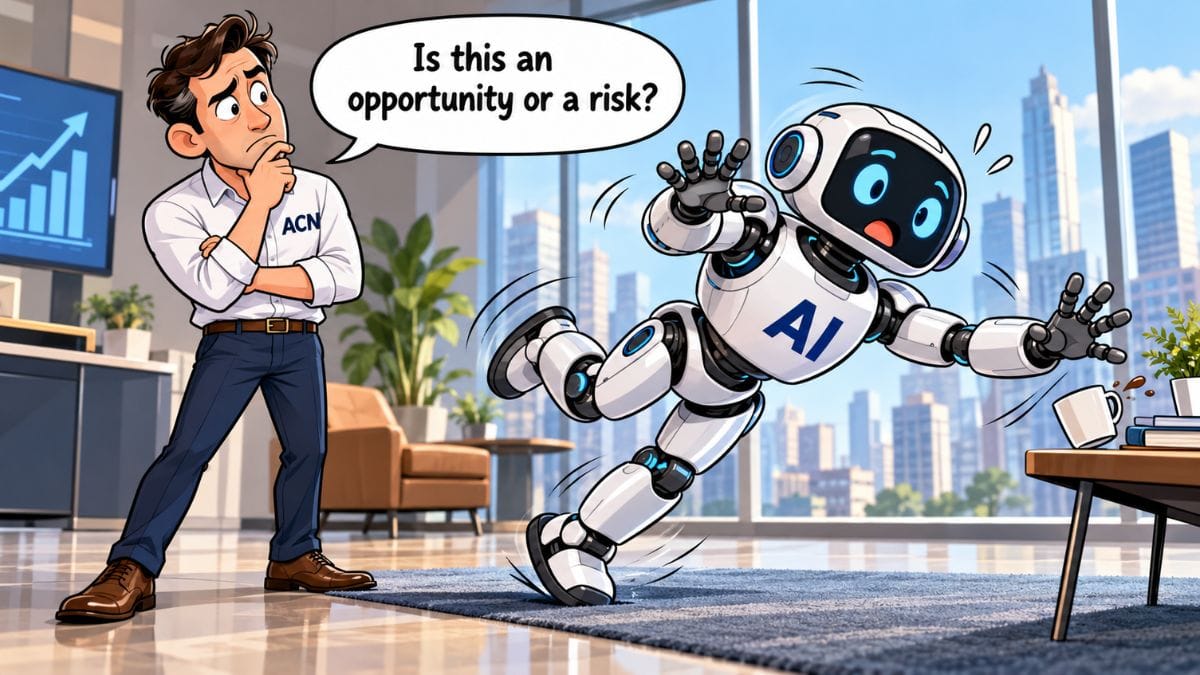
Mikirduit – Accenture (NYSE: ACN) has a business model that AI could disrupt, yet the company is also building a serious AI practice. Even if AI never existed, it could still benefit from other tailwinds. So how attractive is the stock right now?
Key Takeaways
- The cybersecurity deals add revenue, not profit, in the near term. The Dragos, runZero, and NetRise acquisitions bring about $208 million in recurring revenue, under 1% of Accenture’s total. Integration, amortization, and financing costs could limit the benefit to earnings.
- A $38 billion backlog gives Accenture a cushion. About $13.3 billion is expected to become revenue in fiscal 2027, with delayed managed services deals and a possible U.S. federal recovery as added upside.
- AI cuts both ways. Advanced AI work is booming, with more than 400 first-time clients and revenue roughly doubling. But faster work could mean fewer billable hours and tougher pricing at contract renewals.
Here are the key things to watch.
The Cybersecurity Deals Are Still Waiting to Show Up
Accenture agreed to buy a majority stake in Dragos and 100% of runZero and NetRise. Together, the three companies carry an enterprise value of about $4.75 billion. Accenture expects to pay roughly $3 billion in September 2026.
Don’t expect a big impact in fiscal 2027. The three companies had about $208 million in recurring revenue as of June 2026, which is under 1% of Accenture’s total.
Even so, Accenture says these acquisitions, along with Ookla, Whalar, COMWARE, and Faculty, should add 2 to 2.5 percentage points to its fiscal 2027 growth guidance of roughly 3% to 6% in constant currency.
Management also cautioned that the benefit to net income is hard to pin down. Profits could be squeezed by:
- Integration costs
- Product development investment
- Amortization of acquired intangible assets
- Financing costs
Since Accenture will own only a majority share of Dragos, some of Dragos’s profit won’t be consolidated into Accenture’s results. Still, the company is targeting adjusted EPS growth of about 3% to 6% in fiscal 2027, in line with revenue.
A Solid Backlog, Delayed Deals, and Hopes of a Federal Rebound
Accenture enters fiscal 2027 with some cushion. In fiscal 2026 it booked $84.54 billion in new business against revenue of about $74.18 billion. Several contracts were signed late in the fiscal year, so their revenue will mostly land in fiscal 2027.
Backlog is hard to measure precisely, but remaining performance obligations (RPO) were about $38 billion as of May 31, 2026. Roughly $13.3 billion of that is expected to be recognized as revenue in fiscal 2027. That figure doesn’t include new contracts signed in the fourth quarter (June to August 2026).
Two more potential boosts:
- Delayed managed services deals. Management said some contracts slipped out of the third quarter of fiscal 2026 and should start contributing in fiscal 2027. These are separate from fourth-quarter bookings.
- U.S. federal recovery. Accenture’s federal business was a drag in fiscal 2026, costing about 1 percentage point of total growth. The company has felt the effects of U.S. government spending cuts since fiscal 2025. If federal demand for managed services recovers, that would be a welcome tailwind.
 Surya Rianto
AI Cuts Both Ways
The opportunity. In the first quarter of fiscal 2026 (September to November 2025), Accenture booked $2.2 billion in advanced AI work. The company hasn’t shared a full-year figure, but it said more than 400 clients started advanced AI projects for the first time during fiscal 2026, and revenue from this area roughly doubled.
AI also creates a lot of groundwork that clients need help with:
- Cleaning up data
- Connecting legacy applications
- Building data access
- Redesigning customer service, finance, marketing, and supply chain processes
Internally, AI can help Accenture speed up coding, testing, documentation, and analysis.
The risk. AI can also work against Accenture. If AI makes work faster on time-based contracts, there are fewer billable hours. Clients may then push for lower prices at renewal, or decide they need fewer outside consultants.
A possible silver lining. AI progress can be held back by limits on hyperscale data center capacity, power supply, and cooling. If those bottlenecks slow AI adoption, clients may lean on Accenture’s help to navigate them. In that scenario, a risk becomes an opportunity.
The Valuation: Mixed Signals
Versus its own history: ACN’s P/E, EV/EBITDA, price-to-sales, and price-to-book ratios are all below their five-year averages. That partly reflects clients, including the U.S. government, cutting back on spending, which has limited ACN’s growth.
Versus peers: the picture is less cheap.
On P/E, ACN is the second most expensive in the group, behind only TCS. On EV/EBITDA, it ranks third, behind TCS and INFY.
Our Take
We see the best buy zone for ACN at $146.94 to $183.24 per share, with a target price of $267.38 and a risk price of $138.82.
As of October 14, 2026, ACN is trading outside that buy zone, so we’re staying on the sidelines for now.
Mikirduit US provides independent financial research and educational content. This article is not personalized investment advice, and investors should conduct their own research before making investment decisions.