AI Stocks Slide: Is Big Tech’s Spending Spree a Warning Sign?
Alphabet, Amazon and Intel all grew revenue last quarter, yet the Nasdaq-100 fell 3.46%. The reason: soaring AI spending is outpacing cash flow, and Intel’s outlook was cautious. Here is what investors need to know.

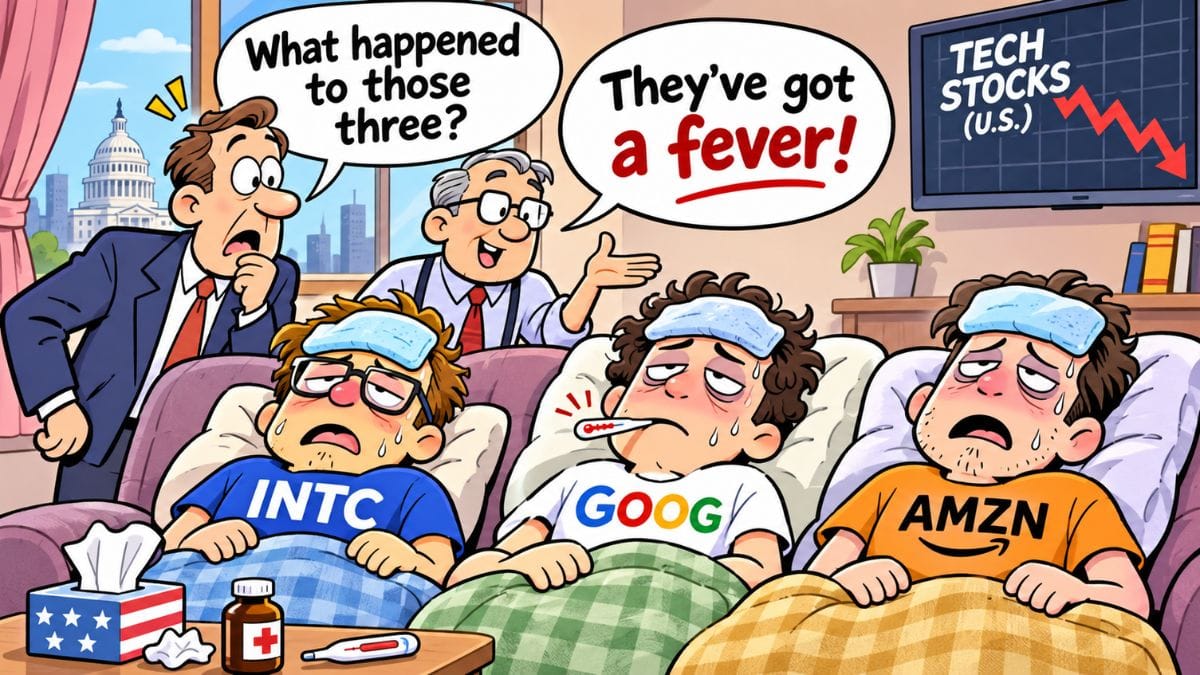
Mikrirduit – U.S. stocks fell sharply on Friday, October 30, 2026, after Alphabet, Amazon and Intel reported earnings, even though none of the three posted clearly bad results.
Key Takeaways
- AI spending is outrunning cash. Alphabet and Amazon both posted negative free cash flow because capital spending grew far faster than operating cash flow (up 114% and 81.8%, respectively).
- AI demand is real, but so are the limits. Google Cloud and AWS are growing fast, with backlogs of $561 billion and $578 billion. Even so, Intel says supply shortages will cap its data center growth until the second half of 2027.
- Risks may take time to show up. A possible Fed rate hike and tight AI infrastructure supply could weigh on AI stocks in 2027 and 2028, so short-term traders and long-term investors should approach the dip differently.
What happened
The Nasdaq-100 dropped 3.46% to 28,384, and the S&P 500 fell 1.82%. On the surface, the three reports looked solid: revenue grew at all three companies, and their AI-related businesses grew even faster.
So why did investors sell? The answer lies in the details. Each company showed a different kind of pressure, from heavy spending and weak cash flow to cautious guidance and supply limits. Here is a closer look at each one.
Alphabet (GOOGL): Missed estimates and negative free cash flow
Alphabet's third-quarter results came in below Wall Street's expectations, and its cash flow raised red flags.
- Revenue: Up 24.7% to $127.57 billion, but 0.31% below analyst estimates.
- Earnings per share: Down 26.1% to $2.12, and 29.57% below estimates.
- Free cash flow: Negative $9.07 billion, the second negative quarter in a row.
The drop in earnings did not come from the core business. Interest expense jumped from $140 million to $970 million, and Alphabet booked an $8.66 billion loss on equity investments, compared with a $10.37 billion gain a year earlier. The loss is estimated to come from its SpaceX stake, which is thought to be down about 12%.
The cash flow problem is a spending problem. Operating cash flow fell 12.6% to $42.29 billion, while capital spending more than doubled, up 114% to $51.36 billion. Accounts receivable rose 64.5% to $3.92 billion and inventory rose 512% to $3.22 billion. The rise in receivables is not an immediate concern, since customers pay in about 50 days on average, which suggests no major collection risk.
The bright spot is Google Cloud. Revenue more than doubled, up 102.6% to $30.71 billion, and operating income rose 209.4% to $11.12 billion. Growth came from AI infrastructure for businesses, AI tools, core cloud services and sales of Google's own tensor processing units (TPUs). One caveat: the growth figure includes revenue from Wiz, a recent acquisition, so not all of it is organic.
Google Cloud also reported a $561 billion backlog of contracted revenue. About 55% of it, or roughly $308.6 billion, is expected to be recognized within 24 months.
Still, there is a margin risk. Because Google has started using third-party computing capacity, Cloud profit margins could be squeezed in the fourth quarter.
Alphabet's main challenges:
- Capital spending is growing much faster than operating cash flow, which pushes free cash flow lower.
- Revenue and earnings per share missed expectations.
- Google Cloud margins may come under pressure in Q4 2026.
Amazon (AMZN): AWS is surging, but spending is outrunning cash
Amazon's story is similar to Alphabet's. Results slightly missed expectations, and free cash flow over the past 12 months was negative $42.4 billion.
- Revenue: Up 12.1% to $201.94 billion, just 0.18% below estimates.
- Earnings per share: Down 3.1% to $1.89, and 3.57% below the analyst consensus.
The earnings decline mostly reflects a tough comparison. In Q3 2025, Amazon booked a one-time, non-operating gain of $9.5 billion from its investment in Anthropic. That gain did not repeat this year.
The free cash flow problem is again about AI spending. Capital spending rose 81.8% to $210 billion, while operating cash flow grew only 28.8% to $168 billion. To cover the gap, Amazon is borrowing more: interest expense rose 214% to $1.69 billion.
AWS, Amazon's cloud unit, is growing fast. Revenue rose 39.3% to $45.98 billion, and operating income rose 55%. Growth was driven by strong demand for AI services:
- Token volume on Amazon Bedrock, its AI model platform, grew almost 17 times from a year ago.
- Spending on Bedrock by Fortune 500 customers rose almost 7 times.
- AWS signed new contracts with companies including Meta, NVIDIA, OpenAI and Salesforce.
AWS also has a $578 billion backlog. Because AWS is a larger business than Google Cloud, that backlog is relatively smaller than Google Cloud's.
Two open questions:
- Selling Trainium chips outside AWS. Amazon plans to begin selling its Trainium AI chips to outside customers by the end of 2027, which could add to results in 2028. But CEO Andy Jassy said that keeping Trainium exclusive to AWS would likely generate more total revenue and free cash flow over five to six years. Outside sales would turn inventory into revenue faster, but they could limit growth in AWS services running on the same chips.
- Lower AI margins. Management said AI could earn lower profit margins than traditional cloud services, but it did not say how much lower on the earnings call. That uncertainty worries investors.
Amazon's main challenges:
- Capital spending is growing faster than operating cash flow.
- Overall Q3 results fell short of expectations.
- AI margins may be lower than in traditional cloud, by an unknown amount.
Intel (INTC): Solid quarter, cautious outlook
Intel's case is different. The stock fell not because third-quarter results disappointed, but because its fourth-quarter guidance did.
- Q3 revenue: Up 20.9% to $16.5 billion, 0.2% above estimates.
- Q3 net income: Down 18.3% to $3.32 billion, due to non-operating items. Operating income actually rose 269% to $2.52 billion.
- Data Center and AI Group: Revenue up 77.8% to $7.32 billion, and operating income up 215% to $3.04 billion.
For Q4 2026, Intel guided to:
- Revenue of $15.5 billion, 9.3% below the $17 billion consensus.
- Non-GAAP earnings per share of $0.25, 43.2% below consensus.
 Surya Rianto
Management explained its caution with several expectations. Client computing and physical AI revenue is expected to fall more than 20% from the prior quarter. Global PC unit sales are expected to drop 12% in 2026, with second-half volume down more than 20%. Another 10% decline is expected in 2027. Intel links this to higher PC prices caused by a spike in memory costs, which has sharply slowed demand from both businesses and consumers.
On top of that, an accident at Intel's Kiryat Gat facility in Israel caused casualties and halted production. Intel estimates it could reduce Q4 revenue by about $300 million and gross margin by about 2 percentage points. Total lost revenue could reach as much as $600 million.
Supply, not demand, limits the data center business. CFO David Zinsner said demand is running ahead of supply, and that Data Center and AI revenue could be up to $10 billion higher than Intel's internal expectations (an expectation, not a backlog). The bottleneck is a shortage of advanced organic substrates used in EMIB, Intel's chip packaging technology. Intel plans to expand substrate capacity by about 40%, but most of the new capacity will not arrive until the second half of 2027.
That means supply could stay tight through mid-2027, even as demand for server chips climbs. The result could be delayed shipments, higher work-in-progress inventory, greater working capital needs and possibly higher packaging costs.
Intel's main challenges:
- Weaker PC demand and the Israel production halt could weigh on results.
- Intel may struggle to meet rising Data Center and AI demand until new EMIB capacity arrives in the second half of 2027.
The bigger risks for AI stocks
Looking across all three reports, two broader challenges stand out for AI-related companies.
First, A possible Federal Reserve rate hike. Higher rates would raise the cost of refinancing debt and increase interest expense on floating-rate loans. They could also hurt the existing, non-AI businesses at companies like Alphabet and Amazon, leaving less cash to fund AI spending. An aggressive tightening cycle could slow the economy and, in turn, cool demand for AI services. (Our own forecast is a possible 50-basis-point hike in December 2026.) This raises a hard question: with such a high cost of capital, can AI be profitable over the long run? best Treasury ETFs if the Fed raises rates
Second, Tight supply for AI infrastructure. Demand for chips, memory, GPUs, electricity and water is very high, but supply is limited. That could slow the buildout of AI capacity. In the worst case, if the money being spent cannot be put to work on schedule, the risk for companies building AI would be significant.
These effects will probably not show up next week or next month. They are more likely to be felt in 2027 and 2028.
What should investors do?
The selloff does not mean the AI boom is over. Demand is strong, and cloud backlogs of $561 billion at Google and $578 billion at AWS show customers are committing real money. But the cost of building AI capacity is rising faster than the cash these companies generate, and that gap is what the market is pricing in.
For investors, the practical takeaways are:
- Short-term traders may find opportunities in the dip, but should take profits quickly rather than hold on.
- Long-term investors should be cautious about treating today's prices as a clear entry point. The risks are still high, and it may be wiser to wait and see how these risks play out before committing.
Mikirduit US provides independent financial research and educational content. This article is not personalized investment advice, and investors should conduct their own research before making investment decisions.