Baidu Looks Cheap, Investors Want Proof That AI Can Fill the Hole Left by Its Fading Core Business
The stock trades below book value and at a steep discount to its rivals, but the search giant's shrinking legacy franchise is outrunning its fast-growing AI unit

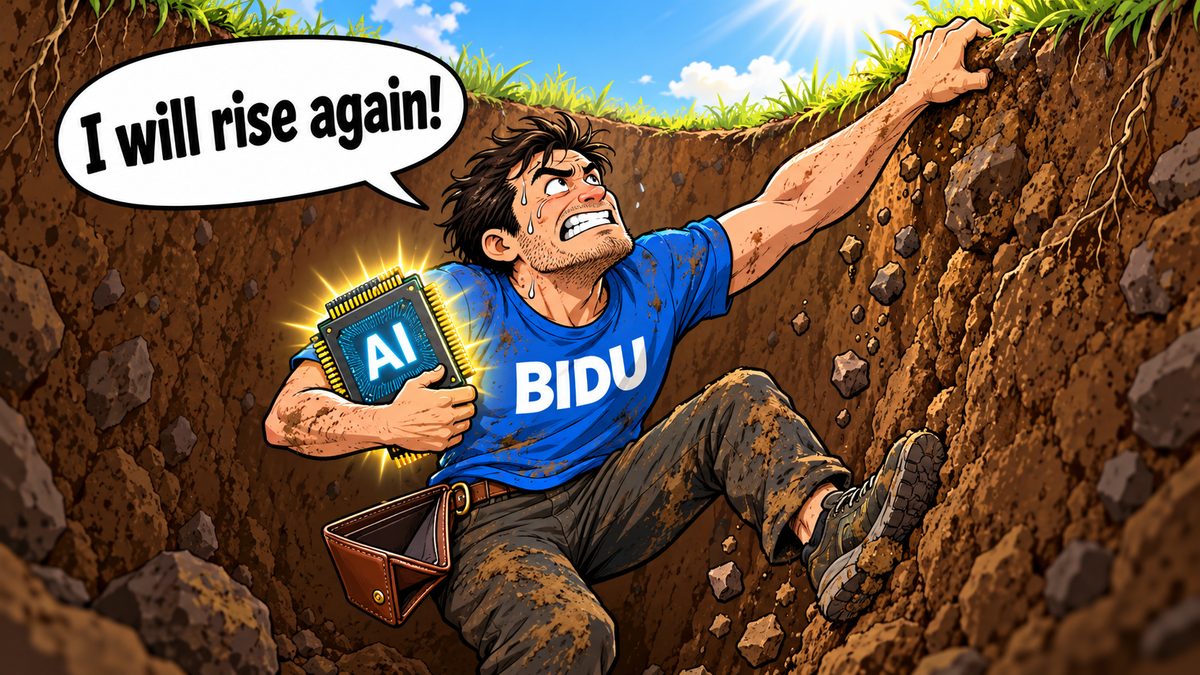
Baidu Inc. is one of the cheapest large technology stocks in the market. Whether it deserves to be is the question.
Key Takeaways
- Baidu looks cheap, but the discount reflects real weakness. BIDU stock is down 47.24% from its Jan. 23, 2026 peak and trades at 2.2x EV/EBITDA and 0.4x EV/revenue, well below Alibaba (12x), Tencent (8.4x) and Alphabet (22.6x). Its core business is still shrinking, with Q2 2026 revenue down 4.2% and advertising revenue down 19%.
- AI cloud is growing fast, but it isn't yet big enough to offset the decline. Baidu's core AI-powered business grew 25% to 12.5 billion yuan and AI cloud infrastructure rose 50% to 7.3 billion yuan. Legacy search and feed revenue fell 23%, so overall revenue still declined.
- Heavy AI spending is pushing free cash flow deeper into the red. Capital expenditures reached 11.39 billion yuan in Q2 2026, and free cash flow was negative 7.95 billion yuan. Baidu's roughly 136.7 billion yuan in net cash gives it room to keep investing, but the stock needs proof that its new AI businesses can earn attractive returns.
Shares of the Chinese search giant (NASDAQ: BIDU) have fallen 47.24% from their Jan. 23 peak through Sept. 29, and now trade at less than book value. The slide follows a second quarter in which profit dropped sharply and its core advertising business continued to shrink.
Baidu's net income fell 68.3% to 2.32 billion yuan in the quarter. Much of the decline stemmed from nonoperating items rather than the underlying business. Foreign-exchange losses nearly doubled to 1.16 billion yuan from 621 million yuan a year earlier, while interest income and earnings from investments also fell.
The operating picture was weaker, though not as dire. Revenue slipped 4.2% to 31.33 billion yuan. Sales at Baidu General Business, which spans search, advertising, cloud, AI applications and intelligent driving, declined 4.1% to 25.18 billion yuan. Revenue at iQIYI, its video-streaming arm, fell 5.1% to 6.29 billion yuan. Operating profit dropped 7.7% to 3.02 billion yuan.
A Growth Engine, but Not Yet a Big Enough One
The bull case rests on artificial intelligence. Baidu's core AI-powered business grew 25% to 12.5 billion yuan in the quarter, led by AI cloud infrastructure, where revenue jumped 50% to 7.3 billion yuan. GPU cloud revenue surged 283%, up from 184% growth in the first quarter, and token usage by external customers of its Qianfan platform rose more than ninefold.
But the growth wasn't enough to offset declines elsewhere. Revenue from search, feed and other legacy offerings fell 23% to 10.4 billion yuan, and other businesses dropped 15% to 2.7 billion yuan.
The AI numbers also come with caveats:
- The 283% jump is a partial figure. GPU cloud is only one piece of AI cloud infrastructure, and Baidu didn't disclose its dollar value, so the growth rate can't be extrapolated to the broader cloud business.
- Momentum is uneven. AI cloud infrastructure revenue fell 17% from the first quarter, suggesting the segment's growth isn't yet consistent.
- The rest of the AI portfolio is soft. AI applications revenue rose just 3% to 2.5 billion yuan, and AI-native marketing services were flat at 2.6 billion yuan. Baidu is adding users to products including Wenku, Baidu Drive, DuMate and Miaoda, but revenue hasn't kept pace.
Cash Is Plentiful, but Spending Is Soaring
Baidu's cash generation improved. Operating cash flow was a positive 3.44 billion yuan, up from 2.67 billion yuan in the first quarter and a negative 0.88 billion yuan a year earlier.
Capital spending is the problem. Capital expenditures hit 11.39 billion yuan, nearly double the first quarter's 5.92 billion yuan and three times the 3.8 billion yuan spent a year ago. As a result, free cash flow was negative 7.95 billion yuan, deeper than the deficits of 3.25 billion yuan in the first quarter and 4.68 billion yuan a year earlier.
The balance sheet gives Baidu room to keep spending. It held 24.5 billion yuan in cash and equivalents, 141.73 billion yuan in short-term investments, and 74.31 billion yuan in long-term deposits and held-to-maturity investments. Against 103.86 billion yuan of interest-bearing debt, that leaves net cash of roughly 136.7 billion yuan.
Whether that cash earns an attractive return is less certain. Baidu's operations are overwhelmingly in China, though it is pushing its autonomous-driving products abroad, including in Dubai, Abu Dhabi, London, Switzerland, Hong Kong, South Korea and Kazakhstan. Its Apollo Go robotaxi service operates in 28 cities and had logged 23 million cumulative rides as of June. Its in-house Kunlunxin chips could improve the efficiency of its AI offerings, but Baidu hasn't given details on profit margins for either business.
 Surya Rianto
How Baidu Stacks Up
Compared with Alibaba Group Holding, Tencent Holdings and Alphabet, Baidu ranks near the bottom on most measures.
Its 7.7% decline in operating profit was the second-worst of the group, though Alibaba's fell 57%. Baidu's operating margin of 9.7% was also second-lowest, ahead of Alibaba's 5.6% but far behind Tencent's 32.9% and Alphabet's 34%.
The gap was widest in digital advertising. Baidu's ad revenue fell 19% to 13.1 billion yuan, while Tencent's rose 22% and Alphabet's grew 17%. Alibaba's declined 7%, though management said it would have risen 1% on an adjusted basis. The contrast points to weaknesses in Baidu's competitive position and its ability to monetize its platform.
In AI cloud infrastructure, Baidu fared better. Its 50% growth topped Alibaba's 45%, though it remains smaller in scale. Alphabet grew 82%. Tencent doesn't report the segment separately.
The Valuation Case
Baidu's discount is stark. It trades at 0.4 times enterprise value to revenue, against a five-year average of 1 time, and at 2.2 times enterprise value to Ebitda, against an average of 4.4 times.
Peers are pricier. On enterprise value to Ebitda, Alibaba trades at 12 times, Tencent at 8.4 times and Alphabet at 22.6 times. On enterprise value to revenue, the multiples are 1.1 times for Alibaba, 3.2 times for Tencent and 8.8 times for Alphabet.
The stock's recovery, analysts say, will depend on Baidu showing that its new businesses can outgrow the erosion in its old ones, and that the legacy franchise doesn't keep shrinking at a double-digit pace. Until then, the cheap valuation may simply reflect the risk.
Mikirduit sees an attractive buy zone of $77.46 to $84.20 a share, with a price target of $102.82 to $111.03. The shares could fall below $75, the worst-case level, if the deterioration in financial performance continues.
FAQ
Is Baidu stock undervalued?
Baidu (NASDAQ: BIDU) trades at 2.2x EV/EBITDA and 0.4x EV/revenue, roughly half its five-year averages of 4.4x and 1x. That makes it cheaper than Alibaba (12x), Tencent (8.4x) and Alphabet (22.6x) on EV/EBITDA. The discount may still reflect real risk, because its search and advertising revenue is shrinking.
Why has Baidu stock fallen?
BIDU shares are down 47.24% from their Jan. 23, 2026 peak through Sept. 29. In Q2 2026, revenue fell 4.2% to 31.33 billion yuan and net income dropped 68.3% to 2.32 billion yuan. Much of the profit decline came from nonoperating items such as foreign-exchange losses and weaker investment income. Baidu's advertising revenue also fell 19% to 13.1 billion yuan.
How fast is Baidu's AI business growing?
Baidu's core AI-powered business grew 25% to 12.5 billion yuan in Q2 2026. AI cloud infrastructure rose 50% to 7.3 billion yuan, and GPU cloud revenue surged 283%. However, AI cloud infrastructure revenue fell 17% from Q1, and AI applications grew only 3%, so the growth has not yet been consistent enough to offset declines in search and feed.
How does Baidu compare with Alibaba, Tencent and Alphabet?
Baidu ranks near the bottom on most measures. Its 9.7% operating margin is ahead of Alibaba's 5.6% but far behind Tencent's 32.9% and Alphabet's 34%. In AI cloud infrastructure, Baidu's 50% growth beat Alibaba's 45%, but trailed Alphabet's 82%. Tencent does not report the segment separately.
Does Baidu have enough cash to keep investing in AI?
Yes, for now. Baidu has roughly 136.7 billion yuan in net cash after subtracting 103.86 billion yuan of interest-bearing debt. But capital expenditures hit 11.39 billion yuan in Q2 2026, pushing free cash flow to negative 7.95 billion yuan. The open question is whether the spending will earn attractive returns.
The numbers are only the beginning.
Every week, Mikirduit US breaks down earnings, valuations, catalysts, and risks across U.S. stocks—so you can see what the market may be missing.
Mikirduit US provides independent financial research and educational content. This article is not personalized investment advice, and investors should conduct their own research before making investment decisions.