
Circle Is Paying $400 Million for Tazapay. Why CRCL Stock Fell—and What the Deal Could Mean
Circle’s $400 million all-stock acquisition of Tazapay could accelerate its push into global payments, but dilution, regulatory risk and a still-premium CRCL valuation remain key concerns.

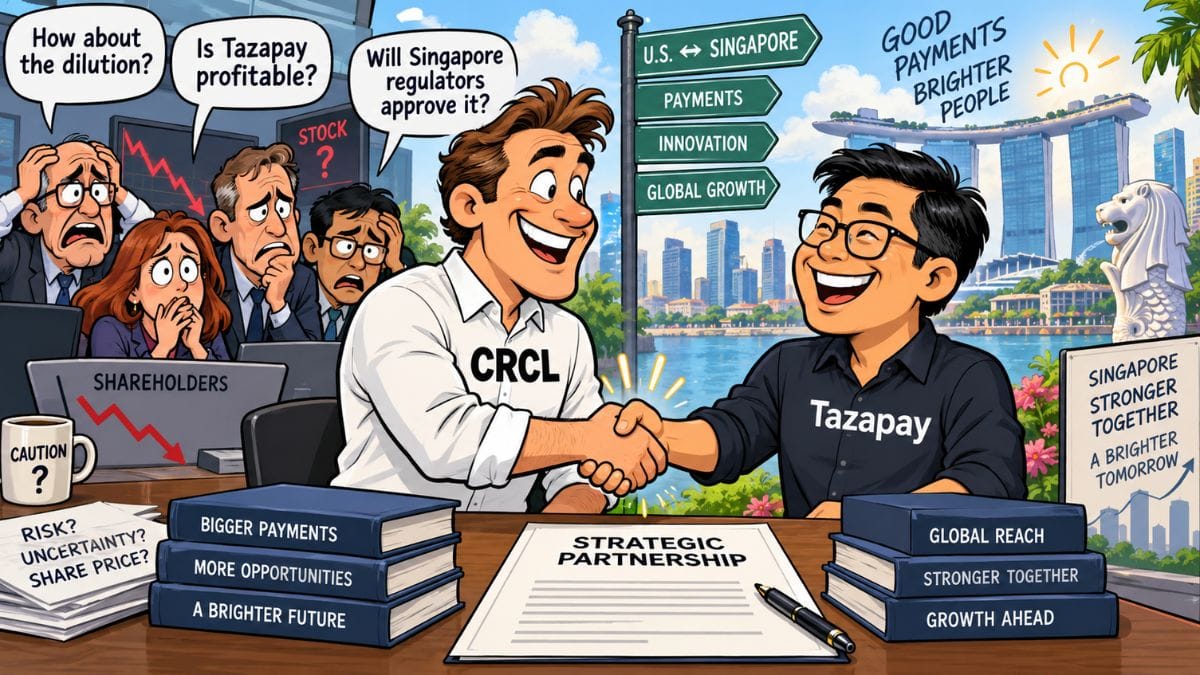
Mikirduit — Circle Internet Group Inc. (NYSE: CRCL) has agreed to acquire cross-border payments company Tazapay in a roughly $400 million all-stock transaction, a deal designed to push the USDC issuer deeper into the infrastructure that actually moves money around the world.
3 Key Takeaways
- Circle’s Tazapay deal could strengthen USDC adoption and expand non-reserve revenue by adding local banking rails and cross-border payment infrastructure.
- The all-stock structure creates dilution risk, with the final impact depending heavily on CRCL’s share price before the transaction closes.
- CRCL still trades at a premium to digital-asset peers, so investors need Tazapay to deliver meaningful strategic and earnings benefits to justify the valuation.
Investors weren't immediately impressed.
Circle shares fell 5.75% to $96.18 on Sept. 8, the day the transaction was announced.
The market's initial concern is understandable. Circle is paying with stock, meaning existing shareholders will be diluted. And because the number of shares ultimately issued depends on Circle's stock price before closing, a further decline in CRCL shares could make that dilution larger.
But the strategic rationale goes well beyond simply buying another payments company.
Tazapay could give Circle something it increasingly needs as it tries to build a business beyond interest earned on USDC reserves: local banking connections, payout rails and cross-border payment infrastructure that can turn stablecoins into an everyday payments network.
For investors, the key question is whether that strategic value will eventually outweigh dilution and execution risk.
Circle Will Pay $400 Million in Stock
Circle entered into a definitive share purchase agreement on Sept. 4, 2026, four days before publicly announcing the transaction.
Under the agreement, a Circle subsidiary will acquire all outstanding Tazapay shares not already owned by Circle or its affiliates.
The purchase price is approximately $400 million, subject to adjustments for Tazapay's cash, debt and transaction expenses.
Instead of paying cash, Circle will issue Class A common shares.
The number of shares will be determined by dividing the final consideration by CRCL's 20-trading-day volume-weighted average closing price immediately before the deal closes.
That creates an unusual dynamic for existing shareholders.
The lower Circle's stock price falls before closing, the more shares Circle has to issue.
How Much Dilution Could CRCL Shareholders Face?
The exact dilution can't be known yet because the closing share price hasn't been determined.
But the mechanics can be illustrated relatively easily.
Assume the $400 million purchase price remains unchanged.
If CRCL's 20-day VWAP before closing were:
| CRCL VWAP | Approx. New Shares Required |
|---|---|
| $50 | 8.0 million |
| $75 | 5.33 million |
| $100 | 4.0 million |
| $150 | 2.67 million |
At a $50 closing VWAP, Circle would need to issue roughly 8 million shares.
At $150, it would need only about 2.67 million.
Using our current-share-count assumptions, that could mean dilution of roughly 1% to 3% across those scenarios.
The key risk is therefore reflexive.
If investors become increasingly concerned about the acquisition and drive CRCL materially lower before closing, Circle may have to issue more shares, increasing the dilution investors were worried about in the first place.
Still, even dilution in the low-single digits wouldn't necessarily make this a bad deal.
The important question is what Circle gets in exchange.
Tazapay Shareholders Won't Necessarily Dump All Their Shares Immediately
There is another detail worth watching.
The shares Circle issues as acquisition consideration won't initially be registered under the Securities Act.
Circle is required around closing to file a prospectus supplement covering resale of the transaction shares, meaning sellers could ultimately gain access to public-market liquidity.
But not every share will necessarily become freely tradable at once.
Five percent of the acquisition consideration will initially be withheld for certain indemnification obligations, with another 3% held back for additional potential claims.
Those shares can be released in installments extending as far as four years after closing.
Tazapay equity awards and shares held by certain management sellers are also subject to restricted-stock agreements.
That doesn't eliminate future selling pressure.
It does mean, however, that the entire $400 million stock consideration shouldn't automatically be viewed as one large block of shares hitting the market immediately after closing.
 Surya Rianto
Why Circle Wants Tazapay
To understand the acquisition, it helps to understand Circle's core economics.
Circle is best known as the issuer of USDC, one of the world's largest U.S.-dollar-backed stablecoins.
At a simplified level, the model works like this:
Circle issues USDC when customers bring dollars into the ecosystem.
Those dollars are backed by reserves held primarily in highly liquid assets such as cash and short-duration U.S. government securities.
Those reserves generate interest income.
Circle shares a portion of the economics with distribution partners and retains the remainder as revenue.
That has been an extremely attractive model when interest rates are high.
It also creates a problem.
A meaningful portion of Circle's earnings power remains connected to interest rates and the amount of USDC in circulation.
If Federal Reserve rates decline, yields on reserve assets eventually decline as well.
That means Circle has a strong incentive to build businesses that generate revenue from transactions rather than simply from holding reserves.
Tazapay fits directly into that strategy.
Circle Is Trying to Build More Than a Stablecoin
Circle has been gradually expanding its infrastructure around USDC.
Its major initiatives include Circle Payments Network, or CPN, which connects banks, fintech companies and payments providers through stablecoin-based settlement.
It also offers developer infrastructure including APIs, wallets, tokenized assets and blockchain integration services.
And Circle is building Arc, its own blockchain designed specifically for financial applications.
The Tazapay acquisition adds another layer.
Tazapay brings banking relationships, local payout connections and cross-border payments infrastructure.
That could allow Circle to increasingly control the entire process:
digital dollars → blockchain settlement → global payments network → local bank account.
Tazapay effectively fills in the final step.
Circle Is Buying the 'Last Mile'
This is probably the most compelling part of the deal.
Moving USDC across a blockchain is relatively easy.
Turning that USDC into local currency and delivering it to the recipient's bank account in markets around the world is much harder.
That requires banking partners, regulatory permissions, foreign-exchange capabilities and connections to local payment systems.
Tazapay has already built much of that infrastructure.
The company says it currently has:
- roughly $25 billion in annualized payment volume,
- relationships with more than 60 banks and fintech partners,
- payout rails spanning more than 100 markets, and
- more than 60% of payment volume involving stablecoins.
In that sense, Circle isn't merely buying payment volume.
It is buying last-mile infrastructure.
Circle can already create and move digital dollars globally.
Tazapay helps turn those digital dollars into money that businesses and consumers can actually receive through their local financial systems.
Why That Matters for Circle Payments Network
The acquisition could also accelerate Circle Payments Network.
Circle launched CPN as an infrastructure layer connecting financial institutions using stablecoins for cross-border settlement.
Tazapay isn't a completely new relationship.
It has worked with Circle since 2025 and was one of CPN's early design partners.
That should reduce some integration risk.
Circle isn't acquiring a company whose technology or operating model it is seeing for the first time.
It is acquiring an existing ecosystem partner that already handles stablecoin settlement at meaningful scale.
That could make Tazapay easier to integrate into CPN than a completely unrelated acquisition target.
Circle Wants to Reduce Its Dependence on Interest Income
This is where the acquisition could become particularly important for CRCL investors.
Circle's reserve-income model can be highly profitable.
But it is also tied to monetary policy.
Higher rates increase yields on short-duration government securities held against USDC reserves.
Lower rates can reduce them.
A broader payments business could eventually generate a different revenue mix.
Potential sources include:
payment-network fees
Circle could charge financial institutions and payment providers for using its infrastructure.
Foreign-exchange revenue
Cross-border payments frequently require conversions between USDC, dollars and local currencies.
API and infrastructure fees
Enterprise customers could pay for access to Circle's software, wallets and settlement services.
Enterprise settlement services
Banks and fintech companies could use Circle's infrastructure to settle transactions through stablecoins.
Treasury services
Circle could provide businesses with liquidity and cross-border treasury-management products.
In other words, the long-term goal is to evolve from:
a company that earns money primarily because USDC reserves generate yield
into something closer to:
a global financial network that earns money whenever digital dollars move.
Tazapay potentially shortens the path between those two models.
The Missing Number: Tazapay's Earnings
There is still one major problem with evaluating the deal.
Circle hasn't provided detailed financial guidance for how much revenue or profit Tazapay could add.
That makes the $400 million price difficult to judge.
Tazapay says annualized payment volume has grown to around $25 billion.
A year earlier, the company said it was processing more than $10 billion annually and had reached operating breakeven.
That suggests rapid growth.
But payment volume isn't revenue.
And revenue isn't profit.
Without information on Tazapay's take rate, gross margins, operating expenses and expected contribution to Circle's earnings, investors can't yet determine whether Circle is paying an attractive price.
That uncertainty matters because even modest dilution becomes less appealing if the acquired business produces very little incremental earnings.
Regulatory Approval Is Another Major Risk
The transaction isn't complete.
Circle expects the deal to close in 2027, subject to customary conditions and regulatory approvals—including approval from the Monetary Authority of Singapore.
That is particularly relevant because Tazapay sits at the intersection of payments, money transmission, stablecoins and financial regulation.
Its operations involve licenses and requirements related to areas including payment services, anti-money-laundering controls, money transmission and stablecoin activities.
The purchase agreement initially allows roughly nine months to complete the transaction.
If specified regulatory approvals remain outstanding, that deadline can be extended, with the outside period reaching as long as 15 months.
The agreement can ultimately be terminated if certain regulatory conditions aren't satisfied.
So regulatory review isn't merely a procedural footnote.
It is one of the transaction's principal closing risks.
When Does Dilution Become a Problem?
At the right price, the dilution doesn't appear particularly alarming.
Suppose Circle issues 3 million to 4 million shares.
If Tazapay meaningfully expands USDC circulation, accelerates CPN adoption and produces new non-reserve revenue streams, dilution of around 1% to 2% could be relatively easy to justify.
The situation becomes less attractive under a different scenario.
Imagine CRCL declines sharply before closing, requiring Circle to issue enough shares to create dilution of 4% or 5%.
Now assume investors subsequently learn that Tazapay generates relatively modest revenue or earnings.
The acquisition math would look substantially worse.
That is why CRCL's stock price before closing matters almost as much as Tazapay's operating performance.
Higher Rates Remain a Near-Term Tailwind
Outside the acquisition, Circle still has one near-term macroeconomic catalyst: interest rates.
Because USDC reserves are invested primarily in cash and short-duration government securities, higher interest rates can support Circle's reserve income.
That makes CRCL unusual compared with many technology and fintech stocks.
For most growth companies, higher rates are generally a valuation headwind.
For Circle, they can also increase the yield generated by its reserve assets.
If Federal Reserve policy remains tighter for longer—or rates move higher—the company's reserve economics could remain favorable.
Over the long run, however, relying too heavily on high rates isn't an ideal growth strategy.
That is exactly why the Tazapay transaction matters.
Valuation: CRCL Still Isn't Cheap
We compared Circle with several publicly traded companies exposed to digital assets and financial infrastructure:
- Coinbase Global Inc. (NASDAQ: COIN)
- Block Inc. (NYSE: XYZ)
- Bullish (NYSE: BLSH)
There is an important caveat.
None is a perfect comparable.
Coinbase operates a crypto exchange and other digital-asset services. Block is a broader fintech and payments company with Bitcoin exposure through Cash App and other initiatives. Bullish operates an institutional digital-asset trading platform.
Circle's business is different from all three.
Still, they offer a rough reference point for how public markets value digital-asset infrastructure.
CRCL Is Near Its Own Historical Book-Value Multiple
At roughly $96 a share on Sept. 8, Circle trades at approximately:
7 times book value.
That compares with an average historical P/B multiple of around:
7.4 times.
At first glance, that could make CRCL look modestly discounted relative to its own trading history.
But the comparison isn't particularly powerful.
Circle only went public in June 2025, meaning its public-market valuation history spans little more than a year.
That is far too short to treat a historical average as a reliable long-term valuation anchor.
CRCL Still Trades at a Large Premium to Peers
Relative to the peer group, Circle's premium is much clearer.
Our estimates put price-to-book multiples around:
| Company | Price-to-Book |
|---|---|
| Circle | 7.0x |
| Coinbase | 3.6x |
| Block | 2.2x |
| Bullish | 2.2x |
Circle is therefore the most expensive company in the group on this metric.
Again, the comparison isn't perfect.
Coinbase is particularly complicated because it is both a major Circle partner and one of the most important distribution channels for USDC.
At the same time, Coinbase has supported other stablecoin initiatives, meaning strategic alignment between the two companies doesn't eliminate competitive risks.
The key takeaway isn't that Circle deserves the same multiple as Coinbase, Block or Bullish.
It is that CRCL's current valuation still assumes significant future growth.
Investors are already paying a premium for the idea that USDC and Circle's broader infrastructure can become major components of the global financial system.
The Bottom Line
The Tazapay acquisition makes strategic sense.
Circle isn't simply buying another fintech company.
It is buying infrastructure that connects stablecoins with local banking systems across more than 100 markets.
That could help Circle increase USDC adoption, accelerate Circle Payments Network and build revenue streams that are less dependent on interest earned from reserves.
The roughly $400 million all-stock price also appears manageable if dilution remains in the low-single digits.
But there are three major uncertainties.
First, CRCL's stock price before closing will determine how much dilution existing shareholders ultimately absorb.
Second, regulatory approvals—particularly in Singapore—could delay or potentially derail the transaction.
Third, and most importantly, Circle hasn't disclosed enough about Tazapay's revenue and earnings to determine whether $400 million is an attractive purchase price.
That leaves CRCL in an unusual position.
The acquisition potentially improves Circle's long-term business model.
But the stock itself still doesn't look obviously cheap.
At roughly seven times book value, Circle trades at a substantial premium to several other publicly traded digital-asset companies.
In the near term, higher interest rates could continue supporting reserve income.
Over the longer term, however, the more important question is whether Circle can successfully transition from earning money on the dollars backing USDC to earning money every time those digital dollars move.
If Tazapay helps make that transition possible, a modest amount of dilution could prove well worth it.
If not, investors may eventually decide Circle paid $400 million for an ambitious payments strategy that has yet to show up meaningfully in earnings.
The numbers are only the beginning.
Every week, Mikirduit US breaks down earnings, valuations, catalysts, and risks across U.S. stocks—so you can see what the market may be missing.
Mikirduit US provides independent financial research and educational content. This article is not personalized investment advice, and investors should conduct their own research before making investment decisions.