Is Wall Street Headed for a 2022 Replay? What Investors Should Know
U.S. stocks fell sharply on October 22, with the S&P 500 down 1.21% and the Nasdaq-100 down 2.9%. Is this a replay of 2022? We compare the two periods and explain why waiting and building cash may be the most sensible approach for now.

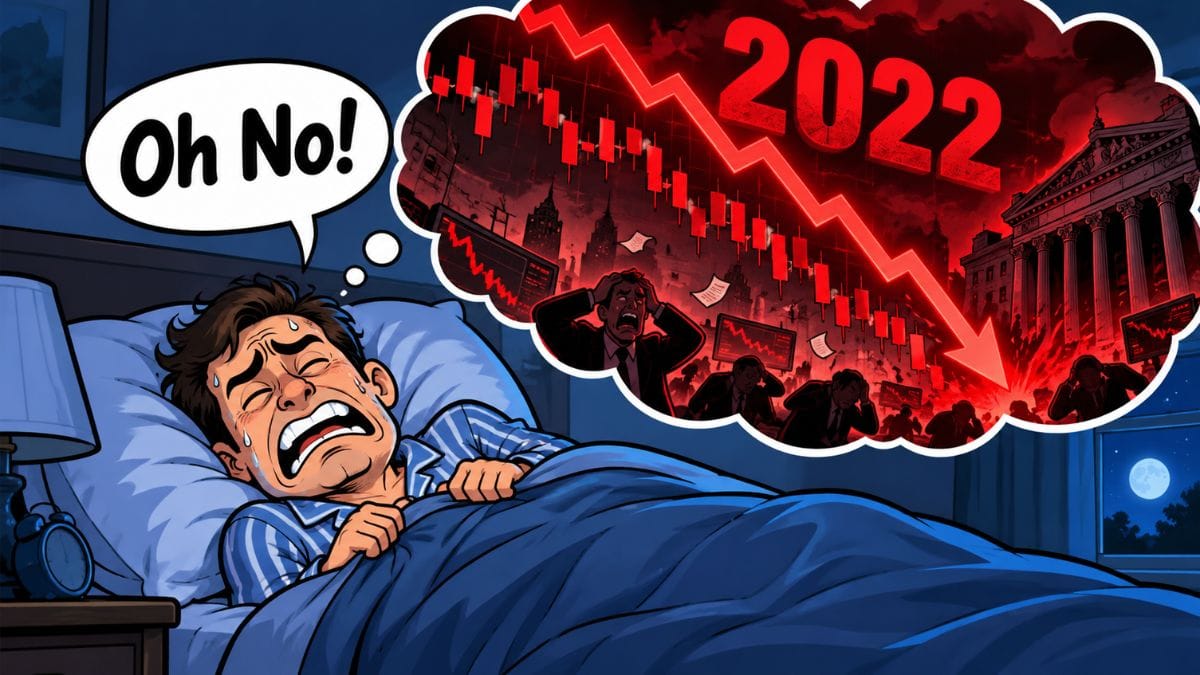
U.S. stocks fell sharply on October 22, 2026. The S&P 500 dropped 1.21%, and the Nasdaq-100 fell 2.9%. The slide has many investors asking whether this is a repeat of 2022. Here is how the two periods compare, and what a cautious investor might do now.
Key Takeaways
- The setup echoes 2022, but the rate pressure is milder so far. Like 2022, a boom sector (AI) is meeting rising interest rates and higher commodity prices. The Fed’s pace is not yet as aggressive as the roughly 300 basis points it delivered in the first nine months of 2022.
- The Fed’s next move is the key signal. A 50 basis point hike in December 2026 could be an early warning for U.S. stocks in 2027, while the path of rate cuts depends on geopolitical tensions and commodity prices easing.
- The biggest risk to watch is AI-related debt. About $850 billion in new AI-linked debt has been issued in 2026, and $37 billion of the $80 billion in bonds is rated junk. A crisis is not the base case, but unpaid loans would raise the stakes.
A Look Back at 2022
The S&P 500 hit an all-time high at the end of 2021. It then fell about 27% over the first ten months of 2022 and did not reach a new record until the end of January 2024. That is roughly two years of waiting.
The main cause was the Federal Reserve. It raised interest rates by about 300 basis points (3 percentage points) in just the first nine months of 2022. Communication services, consumer cyclical, and technology stocks took the biggest hits. Among the hardest hit were Generac Holdings (GNRC), Match Group (MTCH), Tesla (TSLA), Meta Platforms (META), and Sea Ltd. (SE). Didi Global (DIDI) was delisted from the NYSE, though that was largely tied to geopolitics.
Rate hikes hurt in two main ways:
- Consumer cyclical stocks lost momentum. These companies were just recovering from the COVID-19 slump. Aggressive rate hikes raised fears that shoppers would have less spending power.
- Tech companies faced tougher questions. The era of cheap money was over. Investors began asking how both public and private tech firms would turn a profit when borrowing costs were rising and growth might slow.
 Surya Rianto
How Today Compares
Today’s market shares several features with 2022.
A booming sector. Artificial intelligence is the current boom. It covers GPUs, chips, memory, hyperscale data centers, and AI services themselves.
Rising interest rates. The Fed has started raising rates again. The pace is not yet as aggressive as in 2022.
Higher commodity prices. Geopolitical tensions are pushing up commodity prices, although different countries are involved this time.
Together, these pressures are making investors ask a hard question. How will AI companies and hyperscale data center operators make money when borrowing costs are rising, key inputs like GPUs, memory, and chips are expensive, and turning AI services into revenue may be slowing?
The recent news about Anthropic adds to the concern. According to its draft IPO prospectus, the company’s loss for the first half of 2026 reached $80.7 billion, up sharply from $13 billion in the same period a year earlier. After an investor day that pointed to slower revenue growth, investors reportedly began valuing the company at $1.5 trillion, down from $2 trillion.
Could This Pop the AI Bubble?
It depends largely on how fast the Fed raises rates. If the Fed hikes by 50 basis points in December 2026, that could be an early warning for the U.S. stock market in 2027. Rate cuts, in turn, will likely depend on how quickly geopolitical tensions ease and commodity prices cool.
Will there be a financial crisis? No one can predict that. The most likely outcome is a repeat of the market pressure seen in 2022, without a major crisis.
Even in 2022, there were warning signs in the banking system. The Fed’s rate hikes totaled 525 basis points between March 2022 and July 2023. That strained the liquidity of several U.S. banks, including Silicon Valley Bank, Signature Bank, and First Republic Bank. Fortunately, those events did not grow into a crisis like 2008.
For now, the situation appears manageable and far from a 2008-style crisis. The key exception would be if the large loans taken on by AI companies and hyperscale data centers start to go unpaid. That would signal a greater risk to the broader economy.
The amounts involved are large. Data from The Economist and Barclays shows that new debt tied to the AI ecosystem, from chipmakers to AI-related power utilities, has reached $850 billion so far in 2026. Of that, $80 billion is in bonds, and FactSet reports that $37 billion of those bonds are rated junk, meaning below BBB. If this debt runs into trouble, the mildest outcome would resemble Evergrande. That collapse did not trigger a new crisis, but it did change how the market perceived risk.
The Bottom Line
With U.S. stocks near record levels, rate-hike risks rising, and the hyperscale boom under scrutiny, the most sensible approach for now may be to wait and see. Building up cash gives you room to act if the market pulls back and settles. Many stocks and ETFs look risky at today’s prices. Investors who buy in now should be prepared for a recovery that could take two to three years.
Mikirduit US provides independent financial research and educational content. This article is not personalized investment advice, and investors should conduct their own research before making investment decisions.