Pfizer’s Outlook and Risks: Can It Still Pay a 5-6 Percent Annual Dividend?
Pfizer (NYSE: PFE) offers a dividend yield of about 5-6 percent, but patent expirations, rising competition, and falling EPS cloud the outlook. Here is what investors should weigh.

Mikirduit – Pfizer Inc. (NYSE: PFE) is one of the stocks offering an attractive dividend yield of roughly 5-6 percent per year. With PFE’s share price now fairly cheap, what are the stock’s prospects and risks?
Key Takeaways
- The yield looks attractive, but earnings are shrinking. At $27.82 per share, a dividend of $1.40-$1.70 would yield about 5-6 percent. However, adjusted EPS is guided down 9.9 percent to $2.80-$3.00 for 2026.
- Patent expirations are the biggest risk. Eliquis, Ibrance, Xtandi, and Prevnar 13 made up 36 percent of first-half 2026 revenue, and their patents expire in 2026-2027. Competition from products like Vaxcyte’s VAX-31 adds further pressure.
- Growth depends on the pipeline after 2028. Five new candidates, including the obesity drug berobenatide, could become PFE’s next growth engines. The MFN agreement with the U.S. government also gives PFE tariff certainty, though it could squeeze margins.
Challenges Facing PFE Stock
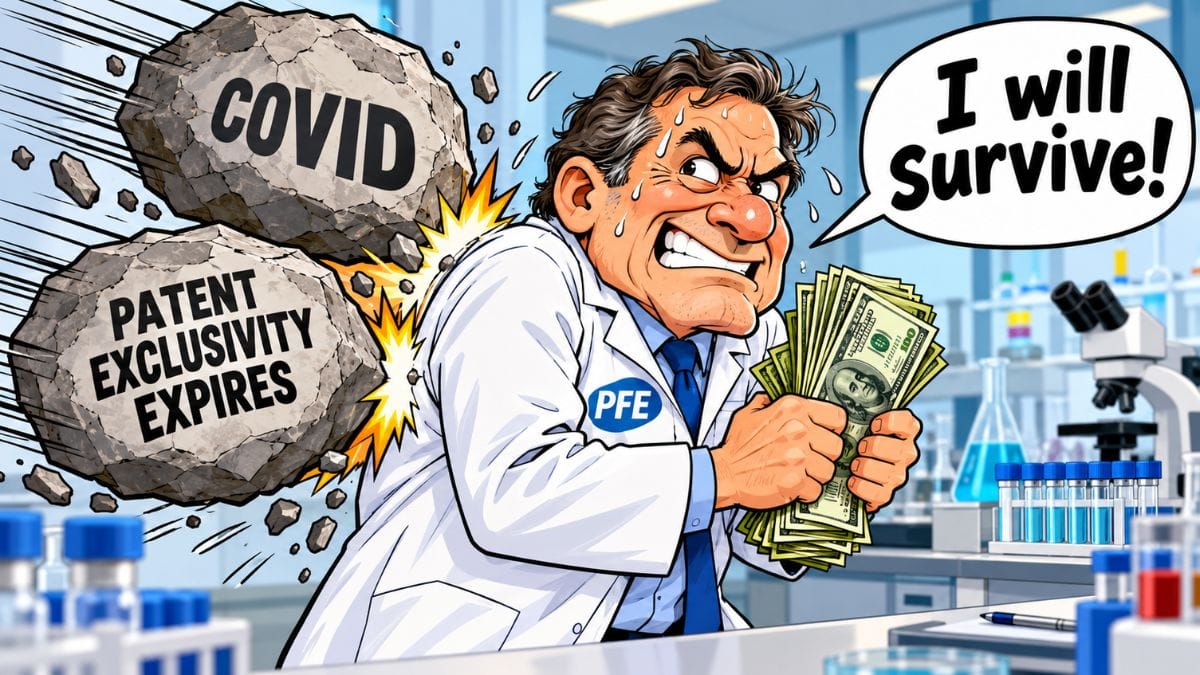
First, PFE’s net income has been under pressure since COVID-19 faded in 2023. That year, net income plunged 93.2 percent to $2.13 billion, compared with $31.37 billion in 2022. The company has gradually begun to grow its financial performance again, although it has not returned to pandemic-era levels.
Second, PFE is about to lose patent exclusivity on several key products, which could hurt its revenue. The patents expiring include:
- Eliquis (anticoagulant): Sales reached $4.59 billion in the first half of 2026. This figure includes revenue from the alliance with Bristol Myers Squibb as well as direct product sales. The patent expires in 2027.
- Ibrance (breast cancer treatment): Sales were $2.07 billion in the first half of 2026. The patent also expires in 2027.
- Xtandi (prostate cancer therapy): Sales were $534 million in the first half of 2026. The patent expires in 2027.
- Prevnar 13 (pneumococcal vaccine): Sales were $3.02 billion, including both Prevnar 13 and Prevnar 20. The patent expires in 2026.
Together, these four products accounted for 36 percent of PFE’s total revenue in the first half of 2026.
Prevnar, whose patent expires in 2026, contributes about 10.27 percent of the company’s revenue. However, that figure also includes Prevnar 20.
Keep in mind that losing patent exclusivity does not mean PFE will lose all of that revenue. It simply means competition on price and products will get tougher as other drugmakers enter the market.
Third, product competition is intensifying. Most recently, Vaxcyte Inc. (NASDAQ: PCVX) completed late-stage clinical trials for its vaccine candidate VAX-31, which could eat into the market share of both PFE and Merck (NYSE: MRK).
VAX-31 targets 31 strains of bacteria that cause pneumonia, meningitis, and bacteremia. The vaccine produced an immune response comparable to PFE’s Prevnar 20 and Merck’s Capvaxive.
 Surya Rianto
PFE’s Growth Drivers
First, PFE has several pipeline products that are not yet on the market, including:
- Berobenatide (a GLP-1 peptide for obesity from Metsera): A weight-loss and type 2 diabetes drug, with first regulatory approval targeted for 2028.
- Mevrometostat (an EZH2 inhibitor): A prostate cancer treatment. There is no firm launch date yet, and it is currently in Phase III clinical trials.
- Atirmociclib (a CDK4 inhibitor): A breast cancer treatment with no firm launch date yet.
- Tilrekimig: A drug for chronic inflammatory diseases and allergies, also with no firm launch date yet.
- 25-valent pneumococcal vaccine: A vaccine to prevent infections caused byStreptococcus pneumoniae (pneumonia, meningitis, and sepsis). It is still in late-stage clinical trials.
These five new products could become PFE’s growth engines after 2028.
Second, PFE is one of the drugmakers that signed a Most-Favored-Nation (MFN) agreement with the U.S. government on September 30, 2025.
The agreement includes the following terms:
- PFE agreed to sell its drugs in the U.S. at prices comparable to those in other developed countries.
- Medicaid programs in all U.S. states will get access to MFN pricing for PFE products.
- PFE will also sell directly to consumers through the TrumpRx.gov platform, where U.S. patients can buy certain drugs at a discount.
- PFE committed to investing $70 billion in U.S. manufacturing development and expansion.
- PFE will be exempt from tariffs on imported pharmaceuticals for the next three years.
- PFE agreed to share additional profits with the U.S. Department of Health and Human Services from higher drug prices charged overseas.
Technically, MFN could squeeze PFE’s profit margins. However, we checked the financial statements and found no detailed disclosure of MFN’s impact on the company’s performance.
Looking at first-half 2026 results, PFE’s gross margin declined only slightly, from 78.51 percent to 76.05 percent.
On the other hand, the MFN deal gives PFE certainty about import tariffs on its drugs.
2026 Guidance and Dividend Potential
When it released its second-quarter 2026 results, PFE management raised its full-year 2026 revenue guidance to a range of $60.5 billion to $62.5 billion. That suggests revenue growth is still flat compared with $62.58 billion in full-year 2025.
Adjusted EPS is expected to fall 9.9 percent to $2.80-$3.00 per share, down from $3.22 in 2025. The decline in the 2026 guidance appears to reflect the loss of exclusivity on one of the company’s patented products.
With adjusted EPS still expected to be above $2.50 per share, we believe PFE has room to pay a dividend of $1.40-$1.70 per share. Based on the October 8, 2026 share price of $27.82, the dividend yield would still be in the range of 5-6 percent per year.
FAQ
What is Pfizer’s dividend yield?
Based on the October 8, 2026 share price of $27.82, the dividend yield is estimated at about 5-6 percent per year, assuming a payout of $1.40-$1.70 per share.
Can Pfizer keep paying its dividend?
The authors believe so. Adjusted EPS is expected to stay above $2.50 per share, which leaves room for a dividend of $1.40-$1.70 per share.
Why did Pfizer’s profit drop?
Net income fell 93.2 percent in 2023, to $2.13 billion from $31.37 billion in 2022, as demand tied to COVID-19 faded. Performance has been recovering gradually but remains well below pandemic-era levels.
Which Pfizer patents are expiring?
Prevnar 13 expires in 2026. Eliquis, Ibrance, and Xtandi expire in 2027. Together, they accounted for 36 percent of first-half 2026 revenue.
Will Pfizer lose all revenue from these products?
No. Losing patent exclusivity mainly means tougher competition on price and products, not a complete loss of sales.
What is the Most-Favored-Nation (MFN) agreement?
Signed on September 30, 2025, it commits Pfizer to sell its drugs in the U.S. at prices comparable to other developed countries. In return, Pfizer gets a three-year exemption from tariffs on imported pharmaceuticals.
What are Pfizer’s key pipeline products?
They include berobenatide (obesity and type 2 diabetes), mevrometostat (prostate cancer), atirmociclib (breast cancer), tilrekimig (inflammatory diseases and allergies), and a 25-valent pneumococcal vaccine.
What is Pfizer’s 2026 revenue guidance?
Management raised full-year revenue guidance to $60.5 billion-$62.5 billion, which is roughly flat compared with $62.58 billion in 2025.
Mikirduit US provides independent financial research and educational content. This article is not personalized investment advice, and investors should conduct their own research before making investment decisions.