
UMC Stock Down 28% in October: Is It a Bargain or Still a “Wait and See”?
UMC shares have dropped as much as 28% in October after a $1.8 billion convertible bond offering and a Q3 earnings miss. Underneath, revenue and margins are improving, but valuation remains above historical norms. Here is what drove the selloff and whether the pullback creates an opportunity.

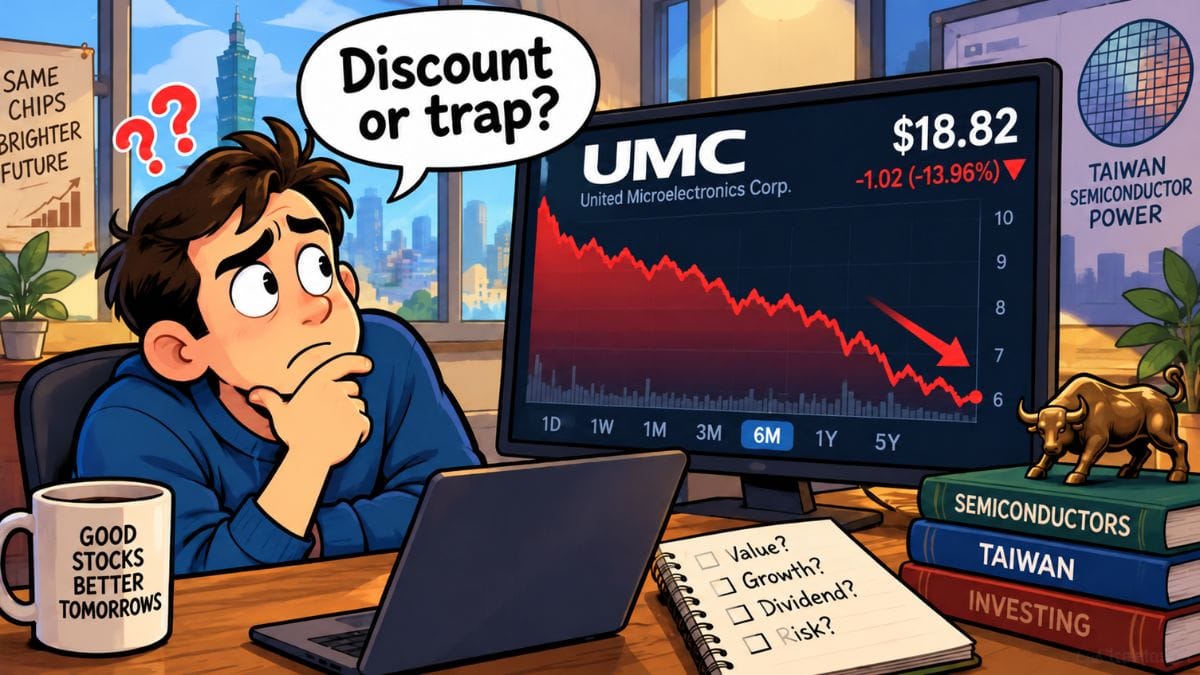
Mikirduit – United Microelectronics Corporation (NYSE: UMC) has fallen as much as 28% between October 2 and October 28, 2026. Here is what drove the selloff, what the business looks like underneath, and whether the pullback makes the stock cheap.
Key Takeaways
- The selloff has a clear cause, but it isn’t a business collapse. UMC fell as much as 28% in October after a $1.8 billion convertible bond offering and a Q3 earnings miss ($0.20 vs. $0.21 to $0.23 expected). Meanwhile, nine-month revenue grew 16.1% and operating margin improved to 22% from 18%.
- Headline profit overstates the recovery. Net income jumped 136.5%, but much of that came from one-time investment gains in Q2. The core growth is real, driven by a 21.2% rise in wafer shipments, but it is volume-led, since average selling prices were flat.
- The stock is still not cheap. At 17.4x earnings and about 11.2x EV/EBITDA, UMC trades well above its five-year averages (11.5x and 5x). It is the cheapest among peers like GlobalFoundries and Tower Semiconductor, so a short-term bounce is possible, but “wait and see” fits the medium term.
What Pushed UMC Shares Lower
First, a $1.8 billion convertible bond offering. On October 5, 2026, UMC announced the pricing of $1.8 billion in convertible bonds. Its U.S.-listed shares fell more than 11% intraday before closing approximately 9% lower, as investors weighed the potential dilution and implications of the new financing.
The offering consists of two $900 million tranches, both carrying a 0% annual coupon. Tranche A matures on October 13, 2031, while Tranche B matures on April 13, 2028.
- Tranche A has an initial conversion price of NT$202.06 per common share, representing a 32.5% premium to UMC's October 5 closing price of NT$152.50 on the Taiwan Stock Exchange.
- Tranche B has an initial conversion price of NT$179.19 per common share, representing a 17.5% premium.
UMC estimates that full conversion of both tranches at their initial conversion prices would dilute existing shareholders' equity by approximately 2.34%, which the company describes as a limited impact.
Because each U.S.-listed ADS represents five Taiwan-listed common shares, the conversion prices are equivalent to approximately $31.82 per ADS for Tranche A and $28.22 for Tranche B, using the bond offering's fixed exchange rate of NT$31.753 per U.S. dollar.
The proceeds are intended to fund machinery and equipment purchases and the construction of manufacturing facilities.
The financing also supports UMC's broader expansion strategy. In July 2026, the company raised its full-year capital expenditure budget to $2 billion and announced plans to expand cleanroom capacity at its Phase 4 facility in Singapore while constructing a new fab building at its Tainan campus in Taiwan.
On October 28, UMC approved approximately $3.2 billion in additional capital expenditure authorization to accelerate capacity expansion, particularly in technologies supporting silicon photonics, advanced packaging, and AI-related applications. However, the company maintained its 2026 cash-based capital expenditure guidance at $2 billion, meaning the newly approved investment should not be treated as spending entirely attributable to 2026.
Second, a third-quarter earnings miss. Analysts expected earnings of $0.21 to $0.23 per share for Q3 2026. UMC reported $0.20, a miss of roughly 4% to 10%. That added to the selling pressure.
The Business Behind the Headlines
Despite the selloff, UMC’s nine-month results show a real recovery:
- Net income rose 136.5% to NT$74.87 billion.
- Revenue grew 16.1% to NT$204 billion.
- Operating income climbed 41.4% to NT$44.87 billion, and operating margin improved to 22% from 18% a year earlier.
- Wafer shipments increased 21.2% to 1.21 million 12-inch equivalent wafers, while capacity rose only 1.5% to 1.32 million.
- Free cash flow was a solid NT$50.96 billion.
One caveat: the headline jump in net income was inflated by a one-time surge in non-operating income, which rose 1,422% to NT$36.87 billion. Most of that came from NT$30.05 billion in investment gains in Q2, which fell back to just NT$1.16 billion in Q3. Those gains come from UMC’s stakes in affiliates and joint ventures, including Hsun Chieh Investment (36.49%), Yann Yuan Investment (26.78%), Silicon Integrated Systems (18.08%), Faraday Technology (13.8%), and Unimicron Technology (12.85%).
Average selling prices were stable, so the growth in revenue and operating profit came from higher volume rather than higher pricing.
 Surya Rianto

How UMC Differs from Nvidia and TSMC
UMC is not a play on cutting-edge AI chips. Nvidia designs its own branded GPUs, and TSMC leads in the most advanced manufacturing nodes. UMC focuses on specialty processes, including mixed-signal, embedded high-voltage, non-volatile memory, RF-SOI, and BCD technologies.
Its revenue mix by end market:
- 39% communications (handsets, broadband, Bluetooth, Ethernet, connectivity)
- 32% consumer electronics and digital devices
- 13% computer and peripheral chips
- 16% other
Possible AI Upside
UMC has a few ways to benefit from the AI boom, even without making the leading-edge chips:
- Advanced packaging, which integrates multiple components into one efficient system, could give UMC specialty manufacturing work that complements high-performance chips.
- Silicon photonics, which uses light to move data through silicon-based components, could help with high-speed, energy-efficient interconnects in computing infrastructure.
- A collaboration with AP Memory, announced October 22, 2026, targets advanced power delivery solutions for AI and high-performance computing systems.
All three remain unproven. Advanced packaging must show it can generate meaningful revenue at attractive margins, silicon photonics is still early-stage, and the AP Memory partnership has yet to show financial results.
Key Risks
- Semiconductor cycle risk. About 71% of Q3 wafer sales came from communications and everyday electronics. A slowdown in device demand could lower factory utilization and squeeze margins.
- Mature-node competition. Capacity at other foundries is growing faster than demand, which could push average selling prices down.
- Capex execution. With a total investment budget of $3.2 billion, UMC will need to deliver faster revenue and cash flow growth to offset higher depreciation and funding needs.
- Geopolitics. Tensions among China, Taiwan, and the United States could disrupt supply chains, especially if technology trade restrictions expand.
The Verdict: Is UMC Discounted Yet?
Not really. Even after the drop, UMC’s valuation is elevated against its own history:
| Metric | UMC Oct 28 | 5-year average |
|---|---|---|
| Price-to-earnings | 17.4x | 11.5x |
| EV/EBITDA | 11.2x | 5x |
On the other hand, UMC is the cheapest of its peers, which include GlobalFoundries and Tower Semiconductor.
Is it an opportunity? For the short term, possibly, but without aggressive positioning. For the medium term, “wait and see” is the more sensible stance.
The biggest near-term risk cited is a potential 50-basis-point Federal Reserve rate hike in December 2026. UMC has some floating-rate bank loans. A 25 bps increase could reduce net income by about NT$45 million, and a 50 bps increase by about NT$90 million.
Mikirduit US provides independent financial research and educational content. This article is not personalized investment advice, and investors should conduct their own research before making investment decisions.