
CleanSpark’s $2.27 Billion Meta Bet Could Transform CLSK—But the Debt Comes First
CleanSpark is betting $2.27 billion on a Meta-backed AI data center, potentially reshaping CLSK from a Bitcoin miner into a hybrid infrastructure play.

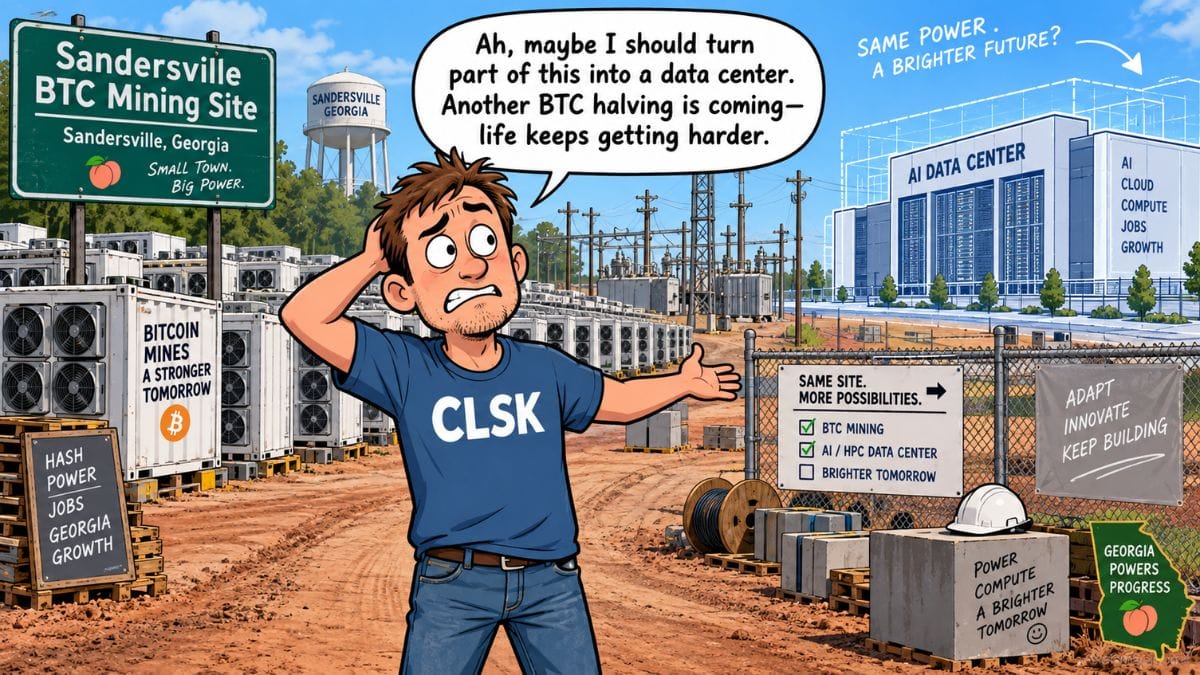
Mikirduit — CleanSpark Inc. (NASDAQ: CLSK) is making one of the most important strategic moves in its history, seeking to convert part of its power and land portfolio from Bitcoin mining into infrastructure for artificial-intelligence data centers.
3 Key Takeaways
- CleanSpark is using $2.27 billion of secured debt to convert part of its Sandersville Bitcoin-mining infrastructure into a 175 MW AI data center backed by a 20-year Meta lease.
- The project could generate about $330 million in average annual NOI, but CleanSpark must absorb roughly $179 million in annual interest before Meta’s rent becomes meaningful in late 2027.
- Our base-case SOTP values CLSK at about $13.27 a share, with upside depending on stronger Bitcoin economics, successful Sandersville execution and potential data-center expansion in Texas.
The company is financing that transition with $2.27 billion of senior secured notes. The move could eventually give CleanSpark a more predictable source of cash flow, but it also introduces a new set of risks at a time when its core Bitcoin-mining business remains highly volatile.
CleanSpark plans to develop a data center with 175 megawatts of critical IT load in Sandersville, Ga. The site was previously used for Bitcoin mining, with its power infrastructure supporting the company’s mining machines.
The economics changed after CleanSpark secured a major tenant: Meta Platforms Inc. (NASDAQ: META).
Meta is expected to provide guarantees covering rent payments and certain operating expenses. The lease is valued at about $6.6 billion over 20 years and includes annual rent escalations of roughly 3%.
Based on company projections, the project could generate average net operating income of about $330 million a year.
The lease also uses a triple-net, or NNN, structure. Under such arrangements, the tenant bears much of the property’s operating costs, including certain taxes, insurance and maintenance expenses.
That structure is one reason the project could produce unusually high operating margins.
But CleanSpark cannot simply convert its existing mining site into an AI data center overnight.
The company must construct the data-center facilities and install the infrastructure required to serve a hyperscale customer. To finance the buildout, CleanSpark issued $2.27 billion of senior secured notes carrying an interest rate of about 7.875% and maturing in 2031.
At an average annual NOI of $330 million, annual interest expense of roughly $179 million would still leave operating income above interest costs.
The bigger issue is timing.
CleanSpark Must Carry the Debt Before Meta’s Rent Arrives
The new debt starts costing CleanSpark money well before Meta begins paying meaningful rent.
For the nine months ended June 2026, CleanSpark recorded just $7.79 million of interest expense. The new Sandersville financing could add roughly $179 million of annual cash interest.
Meta, however, isn’t expected to begin paying rent until around Nov. 30, 2027, when the first network hall is scheduled to be completed.
From Sept. 25, 2026, through the expected start of rent payments, CleanSpark could face roughly $212 million of carrying costs.
Importantly, that $212 million is not expected to come entirely from CleanSpark’s existing corporate cash.
Part of the proceeds from the $2.27 billion financing is being set aside in a debt-service reserve, allowing the project to cover financing costs while construction is still underway.
That doesn’t make the financing free.
If construction is delayed, CleanSpark faces three problems at the same time: higher interest costs, faster depletion of its debt-service reserves and potentially greater capital requirements to finish the project.
A long delay could therefore pressure CleanSpark’s balance sheet even before Meta becomes a meaningful source of cash flow.
 Surya Rianto
Bitcoin Mining Still Drives CleanSpark’s Existing Business
CleanSpark isn’t abandoning Bitcoin mining.
The company controls more than 1.8 gigawatts of contracted power, while the Sandersville data-center project represents only 175 megawatts of critical IT capacity.
CleanSpark also controls roughly 718 acres of land in Texas with potential power capacity of as much as 885 megawatts.
For now, however, Bitcoin mining remains the company’s core business, and its economics depend heavily on four variables.
The first is Bitcoin’s price.
CleanSpark generated about $455.6 million of revenue during the first nine months of fiscal 2026. The value of Bitcoin directly affects both the economics of newly mined coins and the value of the company’s Bitcoin treasury.
By the third fiscal quarter of 2026, pressure on CleanSpark’s mining business was becoming more visible.
Quarterly revenue fell 30.5% from a year earlier to $138 million, partly reflecting weaker Bitcoin economics.
That also fits the broader pattern Bitcoin miners often face later in a halving cycle, when mining economics can become more challenging if Bitcoin prices fail to offset declining block rewards and rising competition.
The second variable is network difficulty, or global hashrate.
Even if Bitcoin remains around $70,000, an increase in global mining capacity can make the network more competitive.
If CleanSpark’s hashrate stays constant while global hashrate rises, the company can receive fewer Bitcoins for the same amount of computing power.
CleanSpark’s recent production illustrates that pressure.
The company mined 671 BTC in May 2026, 614 BTC in June, 586 BTC in July and 593 BTC in August.
Production failed to rise even as CleanSpark maintained substantial computing capacity.
The third variable is electricity.
Mining is effectively a business that turns electricity into Bitcoin. Even relatively small changes in power prices can therefore have a major impact on margins.
If power costs were to increase from 4 cents per kilowatt-hour to 6 cents, mining profitability could deteriorate significantly even if Bitcoin’s price remained unchanged.
CleanSpark’s gross margin declined to 38% from 40% in the prior period, with management pointing to an increase of roughly one cent per kilowatt-hour in power costs from the previous quarter.
The fourth variable is Bitcoin’s halving cycle.
Halvings occur roughly every four years and cut the block subsidy in half. The next halving is expected around 2028.
Unless Bitcoin prices rise enough to compensate, miners typically need greater efficiency, cheaper power or additional scale to maintain profitability after each halving.
CleanSpark has also become more willing to sell the Bitcoin it produces.
Through the third quarter of fiscal 2026, the company said its digital-asset management activities had generated about $25.8 million in cash profit.
Management has made clear that the company views its Bitcoin reserves not simply as a passive asset to hold indefinitely, but as a flexible source of capital.
That philosophy becomes particularly important as CleanSpark shifts more capital toward data-center development.
How the Meta Deal Changes CleanSpark’s Risk Profile
The Sandersville project gives CleanSpark something Bitcoin mining rarely can: long-duration, contracted revenue.
Bitcoin mining earnings can swing based on Bitcoin prices, electricity costs, network difficulty and block rewards.
A 20-year lease backed by Meta offers a very different financial profile.
In effect, CleanSpark is trying to exchange part of its exposure to volatile mining economics for more predictable infrastructure income.
But the trade-off is leverage.
Mining carries high operating volatility.
The data-center strategy adds construction risk, financing risk and a much larger debt burden.
That makes the next 12 to 18 months particularly important.
If Sandersville is delivered on time, CleanSpark could eventually have two distinct earnings engines: Bitcoin mining and recurring data-center income.
If the project is delayed while Bitcoin prices are also weak, however, both sides of the business could come under pressure at the same time.
Valuing CleanSpark With Its Emerging Data-Center Business
We also estimated CleanSpark’s value using a sum-of-the-parts, or SOTP, approach.
Our base case assumes Bitcoin at $90,000, a Bitcoin-mining enterprise value of about $1.08 billion and a valuation of 15 times average NOI for the Sandersville data-center business.
Under those assumptions, CleanSpark’s implied value is roughly:
$13.27 a share.
That is below the latest market price of about:
$14.47 a share.
For the implied value to move clearly above $20, several things would likely need to go right at the same time.
Bitcoin would probably need to approach $120,000, mining profitability would need to recover sharply and Sandersville would need to command a valuation closer to 15 to 18 times NOI.
Such a scenario could become more plausible in the second half of 2027 if Bitcoin begins entering the stronger part of its pre-halving cycle and if Sandersville construction continues to de-risk.
The opposite scenario is also possible.
If Bitcoin falls back toward $60,000 and mining profitability weakens, our implied valuation falls below $13 a share.
That makes Bitcoin one of the biggest swing factors in CleanSpark’s valuation even as the company expands into data centers.
Texas Could Be the Next Major Catalyst
CleanSpark has another potentially significant asset: roughly 885 megawatts of power capacity across its Texas portfolio.
If those sites were eventually developed into AI data centers under economics similar to Sandersville, they could add considerable value to the company.
But investors should treat Texas as optionality rather than contracted backlog.
Sandersville already has a definitive lease and a large tenant.
Texas remains at an earlier stage.
If CleanSpark eventually signs another large hyperscale tenant under a structure similar to Sandersville, the Texas portfolio could become another major catalyst for the stock.
For now, however, CleanSpark remains a company in transition.
In the short term, the shares could remain highly volatile because investors are pricing both Bitcoin-cycle risk and execution risk around the Sandersville project.
A decline below $13 a share toward late 2026 or the first half of 2027 could make the stock more interesting as a speculative opportunity, particularly if Bitcoin begins recovering and Sandersville remains on schedule for Meta rent to begin around November 2027.
The larger question is whether CleanSpark can successfully turn its power portfolio into a second business that is less dependent on Bitcoin.
If Sandersville works as planned, CleanSpark may no longer be valued simply as a Bitcoin miner.
It could increasingly be viewed as a hybrid digital-infrastructure company with exposure to both Bitcoin and the AI data-center boom.
The numbers are only the beginning.
Every week, Mikirduit US breaks down earnings, valuations, catalysts, and risks across U.S. stocks—so you can see what the market may be missing.
Mikirduit US provides independent financial research and educational content. This article is not personalized investment advice, and investors should conduct their own research before making investment decisions.