
Fortinet vs. F5: Two Cybersecurity Stocks Down About a Third. What the Latest Earnings Show
Fortinet and F5 have each lost roughly 33% since mid-October, even as both reported revenue growth and rising AI demand. We break down guidance, margins, inventory and legal risks from their latest earnings, and what investors should watch next. Educational content, not investment advice.

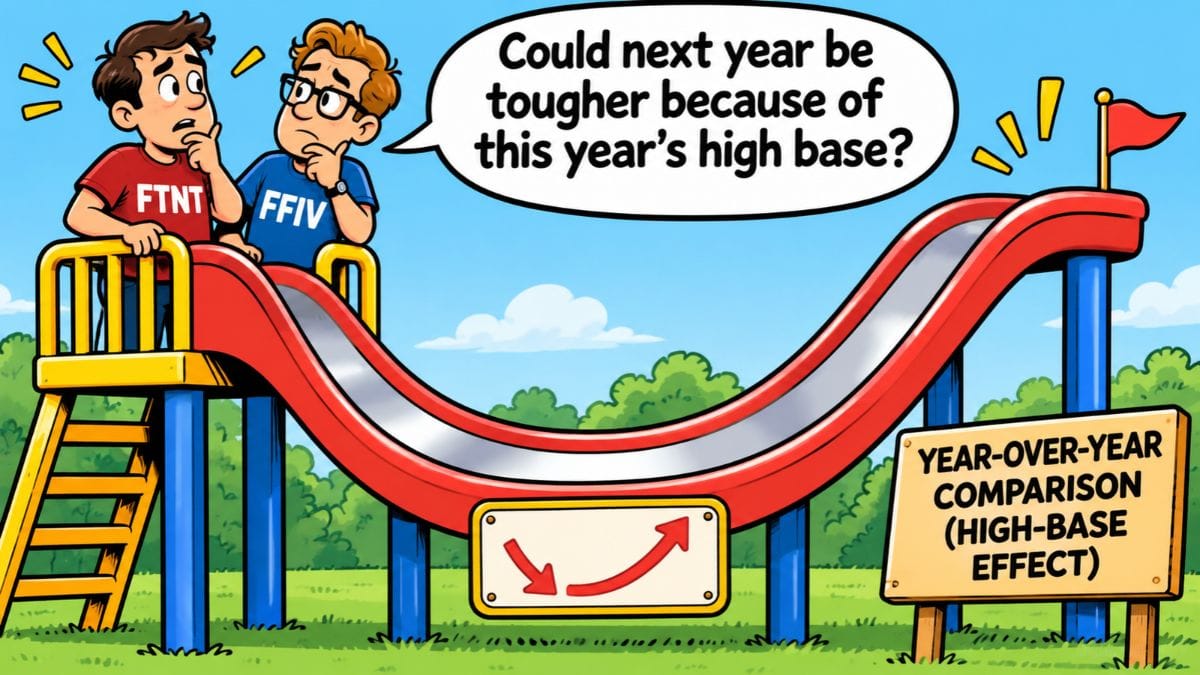
Mikirduit – AI is accelerating the speed and volume of cyberattacks, which should in theory support security spending. Yet FTNT and FFIV have moved differently from many cybersecurity peers. FTNT closed at $131.81 on November 18, 2026, and both stocks have lost about a third of their value since mid-October.
Key Takeaways
- Fortinet (NASDAQ: FTNT) and F5 (NASDAQ: FFIV) have each fallen roughly 33% between October 12 and November 18, 2026, even though both reported growing revenue and strong AI-related demand.
- The selloff appears tied to slowing expectations, not to deteriorating business results. Fortinet trimmed its 2026 service revenue outlook, and F5 guided to slower growth and lower margins for fiscal 2027.
- Both companies built up inventory. Both also reported working-capital explanations, which investors should monitor.
- Valuation, risk tolerance and your own time horizon matter more than any single quarter. Review the primary filings before making decisions.
Here is what the companies’ own reports say.
Fortinet (FTNT): Strong Quarter, Cautious Signals
Fortinet reported third-quarter 2026 results on October 28. The headline numbers were strong:
| Metric (Q3 2026) | Result | Year-over-year |
|---|---|---|
| Revenue | $2.08B | +20% |
| Product revenue | $765M | +37% |
| Service revenue | $1.31B | +13% |
| Billings | $2.34B | +29% |
| Non-GAAP operating margin | 38.2% | up from 36.9% |
| Free cash flow | $865M | up from $568M |
Fortinet also raised its full-year 2026 revenue outlook to about 20% growth. So why the pressure? The answer is in the details of its guidance.
What may be weighing on the stock
- Service revenue outlook was trimmed. Fortinet now expects 2026 service revenue of $5.15B to $5.17B, down from a prior range of $5.18B to $5.22B, a cut of roughly 0.8% at the midpoint.
- Growth is expected to slow. The Q4 guidance midpoint implies about 15% revenue growth and 20% billings growth, compared with 20% and 29% in Q3.
- Margins are shifting. Product revenue is growing much faster than services, and product carries lower margins. Product gross margin fell to about 64.4% from about 67.7%, and GAAP gross margin slipped to 79.0% from 80.8%.
- Security operations growth slowed. Annual recurring revenue (ARR) for AI-driven security operations grew 16%, versus 30% a year earlier. Billings growth in that segment was 15%, versus 39%. This segment is about 10% of total billings.
- Inventory rose. Inventory was $591.2M at September 30, up about 48% from $399.5M at year-end 2025. Over the same nine months, revenue grew about 22% year over year. Inventory that grows faster than sales can become a risk if demand cools. Fortinet’s cash flow statement also shows the build as a cash use.
 Surya Rianto

Potential opportunities
- Operational technology (OT) security. Billings grew nearly 40%, which Fortinet attributes in part to AI infrastructure and data center buildouts. The risk is that demand could normalize if that buildout slows.
- Cross-selling to existing customers. Fortinet cites more than 1 million lifetime customers, SD-WAN penetration above 70% in large enterprises, and SASE penetration around 20%. If it converts SD-WAN users to SASE, recurring revenue could grow.
- New AI security services. Fortinet announced FortiGuard Inline AI Security Services and named partnerships with NVIDIA and Oracle. Fortinet has not disclosed revenue or ARR for these products, so this remains a potential opportunity, not a demonstrated one.
F5 (FFIV): Accelerating AI Demand, but a Slower 2027 Outlook
F5 reported fiscal fourth-quarter 2026 results on October 27.
| Metric | Q4 FY26 | Full-year FY26 |
|---|---|---|
| Revenue | $917M (+13%) | $3.42B (+11%) |
| Product revenue growth | +23% | +19% |
| Systems revenue growth | +29% | +31% |
| Software revenue growth | +19% | +8% |
| Non-GAAP operating margin | 33.7% (vs. 37.0%) | 35.1% (vs. 35.2%) |
| Non-GAAP EPS | $4.42 | $17.49 |
What may be weighing on the stock: the fiscal 2027 outlook
- Revenue growth is guided to 8% to 9%, down from 11%.
- Systems growth is expected to slow from 31% to the upper single digits, while software is expected to accelerate to double digits.
- Non-GAAP operating margin is guided to 33% to 35%, versus 35.1% in FY26. Non-GAAP gross margin is guided to 80.5% to 82.5%, versus 84.0%, which is a larger step down than the operating margin guide alone suggests.
- Non-GAAP EPS is guided to $18.00 to $18.30, about 3% to 5% above FY26.
Other risks to monitor
- Cash flow dipped in Q4. Free cash flow was $91M, compared with $281M in Q3. F5 says this reflected deliberate inventory builds and supplier prepayments to secure supply for FY27. Inventory rose to $262M from $77M a year earlier. Full-year free cash flow remained solid at $869M, and F5 used 69% of it for buybacks. The board also authorized another $1.5B in repurchases.
- Security is still a minority of revenue. Total security revenue was about $1.3B, or roughly 38% of sales, though its growth accelerated to 10% from 6%.
- Legal and reputational exposure from the 2025 cyber incident. F5 disclosed in October 2025 that a nation-state actor had breached its internal systems. Its filings show $28.0M of related costs in FY26, partly offset by $10M of insurance recoveries. Shareholder lawsuits and law-firm investigations have been reported, and we have not independently verified their current status. Check F5’s SEC filings (10-K and 10-Q) for the latest disclosures. AppLovin (APP) Stock Is Down 35% in 2026: Can It Rebound in 2027?
Potential opportunities
- Direct AI use cases. F5 reported more than $100M in FY26 bookings from AI data delivery, AI factory load balancing and AI runtime security. That is up about 300% year over year, with more than 200 direct AI customers, up 4x.
- Large financial-sector wins. F5 described an eight-figure deal with a North American financial institution, plus wins at central bank–related organizations in Asia and a European bank. An eight-figure deal ($10M to $99.9M) would equal roughly 0.3% to 2.9% of FY26 revenue. F5 did not disclose exact contract values.
- New AI-powered products. More than 300 customers have adopted the AI-powered Distributed Cloud WAF since its March launch, with over 75% using blocking mode. Over 200 customers use F5 Insight. These figures show adoption, but F5 has not disclosed related revenue.
How They Compare
| Fortinet | F5 | |
|---|---|---|
| Core business | Firewalls, networking, SASE, security operations | Application delivery and application/API security |
| Latest reported growth | Revenue +20% (Q3) | Revenue +13% (Q4) |
| Key concern | Slowing Q4 guide, service outlook trim, margin mix, inventory | FY27 growth and margin guide, Q4 cash flow, incident-related litigation |
| AI evidence | Product launches and partnerships; revenue not disclosed | Disclosed AI bookings and customer counts |
| Valuation (EV/EBITDA)* | 33.6x, below its 5-year average | 18.4x, above its 5-year average of 17.5x |
*Valuation figures are from our data screen and will vary by data provider and date. Verify before relying on them.
The Bottom Line
Both companies are guiding to more normal growth after a strong 2026, which suggests demand normalization more than business breakdown. The key differences:
- Fortinet has the faster growth and stronger cash generation, but it carries a higher valuation multiple and watch items in services growth, security operations and inventory.
- F5 trades at a lower multiple and gives more detail on AI revenue, but it faces slower growth, lower guided margins, and legal and reputational risk from its 2025 breach.
Given the legal overhang at F5 and the growth profile of each company, we think Fortinet merits deeper research. That is not a recommendation to buy or sell.
What to watch next: Fortinet’s Q4 results and any 2027 outlook, F5’s Q1 FY27 results (guided to $875M to $895M in revenue), inventory and cash flow at both companies, and any disclosed revenue from the new AI products.
Mikirduit US provides independent financial research and educational content. This article is not personalized investment advice, and investors should conduct their own research before making investment decisions.