
NVDA vs. AMD After the Selloff: Is Nvidia Really “On Sale”?
Nvidia is down 29% and AMD is down 21% since early October 2026. We compare growth, margins, cash flow, valuation, and rate-hike risk so you can judge each stock yourself.

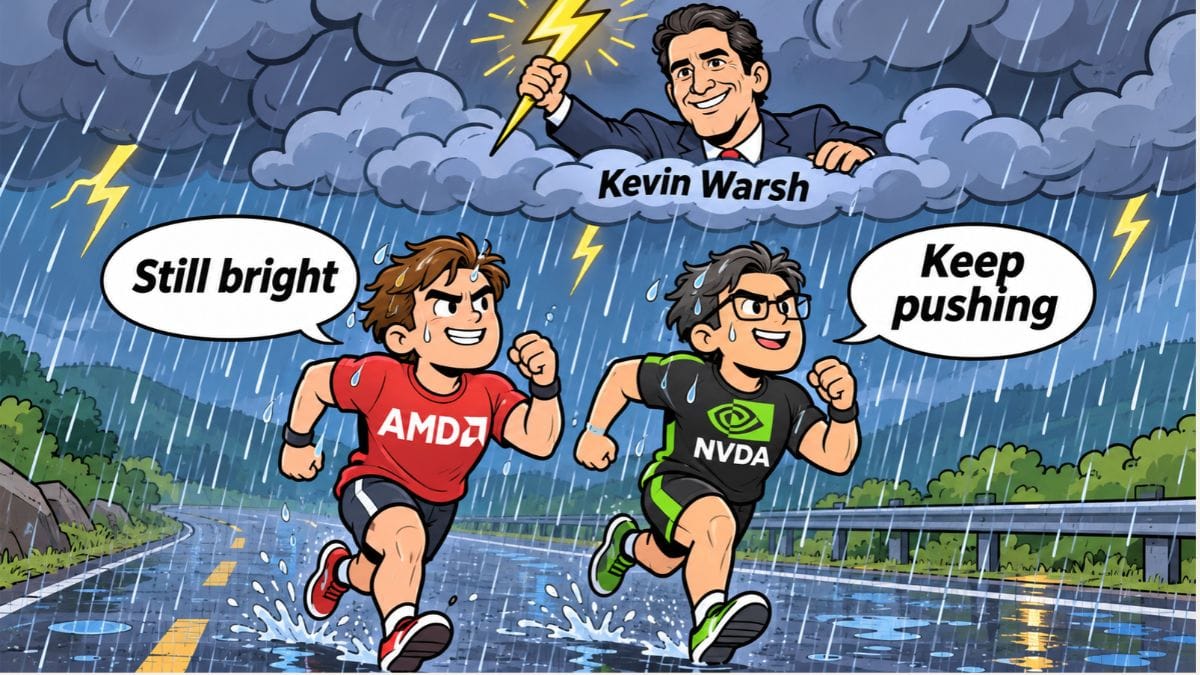
Mikirduit – In just five weeks, Nvidia has lost nearly 30% of its value, and AMD has dropped more than 20%. For investors who spent the past two years watching AI chip stocks climb, the question is now hard to avoid: is this a rare discount, or an early warning?
Key Takeaways
- Between October 6 and November 10, 2026, Nvidia (NASDAQ: NVDA) fell 29.37% and Advanced Micro Devices (NASDAQ: AMD) fell 20.63%.
- On enterprise value to EBITDA, NVDA trades at 19.9x versus its five-year average of 58.5x. AMD trades at 75.2x versus its five-year average of 51.6x. On this one measure, NVDA looks cheaper.
- A cheaper multiple does not mean a safer stock. Both companies face rate-hike risk, heavy dependence on AI spending, and weaker free cash flow in their latest quarters.
- Markets are pricing a 25 basis point (bp) Fed hike on December 9, 2026 at 86.5%, with a 50 bp hike at 13.5%, according to the CME Group FedWatch tool. The 50 bp probability has been rising.
The answer is less obvious than the price tags suggest. With the Federal Reserve widely expected to raise rates on December 9 and AI spending under a closer microscope, both stocks face real risks alongside real opportunities. Here is how NVDA and AMD compare on growth, margins, cash flow, and valuation.
Two forces are weighing on AI chip stocks.
1. Higher rate expectations. After the October inflation data was released on November 10, traders raised the odds of a larger Federal Reserve hike. A 25 bp hike is still the base case, but the odds of 50 bp have been climbing.
2. A possible AI spending slowdown. Higher rates raise financing costs for data center builders. If even one major AI spender signals a slowdown in 2027, sentiment toward both chipmakers could weaken quickly.
Chip stocks often move on expectations about future spending, not just on current earnings.
Nvidia (NVDA): Opportunities and Risks
Opportunities
Strong demand, limited supply. Management says AI demand still exceeds its production capacity. It expects revenue growth of about 70% in fiscal 2028, which covers most of calendar 2027. This follows fiscal Q2 2027 revenue of $96.22 billion, up 106% year over year.
The Vera Rubin platform. Vera Rubin began shipping in August 2026. Management estimates it could generate about $40 billion in revenue per gigawatt (GW) of data center capacity, versus roughly $25 billion for Grace Blackwell and $18 billion for Hopper. It is expected to represent about 20% of data center revenue by fiscal Q3 2027. That means Nvidia can earn more per AI factory without needing proportionally more projects.
A broader customer base. In fiscal Q2 2027, hyperscaler revenue grew 102% to $48.71 billion. Revenue from AI clouds, industrial, and enterprise customers (including sovereign AI) grew 138% to $40.31 billion. One caution: many “non-hyperscale” customers are neoclouds that rent capacity to hyperscalers, so true customer diversification is smaller than the segment split suggests.
Agentic AI. CEO Jensen Huang has said AI agents can use 15 to 100 times more compute than a standard AI interaction. If agent adoption grows, demand could come from everyday AI usage, not only from training new models.
New revenue lines. Nvidia is expanding into CPUs, networking, and Groq 3 LPX. Grace CPU revenue has already passed $5 billion over the trailing twelve months, and management expects CPU revenue to double by 2028. Nvidia is also starting revenue-sharing arrangements with some AI cloud partners, adding income beyond one-time hardware sales.
Abeona (ABEO) Stock Drops 39% After Q3 Miss: What to Know: how a revenue miss, margin pressure, and dilution can reshape a stock’s outlook.
Risks
Large financial commitments. According to CFO Colette Kress, Nvidia carries:
- $279 billion in supply and capacity commitments
- $87 billion in cloud, lease, equity, and other capex commitments
- $56 billion in additional commitments
- Up to $108 billion in maximum gross guarantee exposure
If customers or data center partners hit financial trouble, these obligations could hurt Nvidia.
Circular financing. Nvidia has invested nearly $50 billion in frontier AI labs, and some of those labs buy Nvidia infrastructure. Management expects supported AI labs to account for about one quarter of fiscal 2028 results. If those labs fall short on revenue or cash flow, growth could suffer.
Margin pressure. Higher memory costs are expected to lower gross margin from 75% in fiscal Q2 2027 to 71–72% in fiscal Q4 2027, before it stabilizes at 72–73% in fiscal 2028. On an illustrative $680 billion of fiscal 2028 revenue, each 3 percentage points of gross margin equals about $20.4 billion of annual gross profit.
Cash flow lagging earnings. Quarterly free cash flow fell 56% while operating income grew 19%. Days sales outstanding rose from 45 to 60 days. Part of this reflects working capital for the Vera Rubin ramp, so it is not yet proof of a problem, but investors should watch whether receivables and inventory keep outpacing revenue.
Customer returns and custom chips. Data center owners must earn enough from renting compute to cover investment, power, financing, and operating costs. If GPU supply outgrows demand, rental rates could fall. Custom chips built by hyperscalers could also take over some workloads.
 Surya Rianto

AMD: Opportunities and Risks
Opportunities
Data center momentum. In Q3 2026, AMD’s data center revenue rose 97% to $8.55 billion, and operating income rose 168% to $2.88 billion. The segment is now 63.9% of total revenue. AMD does not separate AI GPU revenue from server CPU revenue, so we cannot tell how much growth came from Instinct GPUs versus EPYC processors.
A fuller AI platform. AMD now offers the Instinct MI450 accelerator, EPYC “Venice” server CPUs, the Helios rack-scale system, and the ROCm 10 software stack. AMD says Anthropic, Meta, Microsoft, OpenAI, and Oracle Cloud Infrastructure are running workloads on early Helios systems. However, early deployments do not guarantee large purchase contracts, and AMD has not disclosed order values, shipment volumes, or contracted backlog.
ROCm versus CUDA. ROCm is AMD’s answer to Nvidia’s CUDA software ecosystem. A more mature ROCm lowers the barrier to adopting AMD GPUs, but commercial adoption still needs to be proven.
Inference focus. AMD’s acquisition of Taalas adds silicon designed for inference, the step where a trained model produces answers. Inference demand grows with every AI app user. AMD has not yet given revenue projections for this move.
Diversification. EPYC is gaining cloud adoption (Oracle, Google Cloud, and Microsoft). The embedded segment grew 29% with an operating margin of about 41%. Even so, data center is roughly two-thirds of revenue, so AMD is still exposed to an AI spending slowdown.
Risks
Tougher comparisons. After 97% data center growth, 2027 growth could slow, perhaps to 30–40%. That would still be strong, but a sharp deceleration can disappoint investors. A pause in cloud spending would make it worse.
Weaker free cash flow. Q3 2026 free cash flow fell 63.8% to $554 million even as revenue rose 45% and operating income rose 123%. Inventory grew by $3 billion and receivables by $1.93 billion. Over nine months, free cash flow is still up 36% to $4.68 billion, so the key question is whether the Q3 drop is temporary.
Competition and margins. AMD must compete with Nvidia and with custom chips on hardware, software, efficiency, and delivery. Management guided non-GAAP gross margin to 55% in Q4 2026, down from 56% in Q3. One point is not evidence of a price war, but it is worth tracking.
Gaming and client weakness. Gaming revenue fell 40% year over year. Client revenue rose 7% year over year but fell 4% from the prior quarter. Combined client and gaming operating income fell 34%. These segments are 28% of revenue, so AMD leans even more on AI infrastructure.
Valuation: NVDA vs. AMD
| Metric (as of Nov 10, 2026) | NVDA | AMD |
|---|---|---|
| EV/EBITDA | 19.9x | 75.2x |
| Five-year average EV/EBITDA | 58.5x | 51.6x |
| Price change, Oct 6 – Nov 10 | −29.37% | −20.63% |
On this measure, NVDA trades well below its own history and far below AMD, while AMD trades above its five-year average. But multiples are only one lens. NVDA’s lower multiple partly reflects growth that has already happened, and the market may be pricing in slower growth ahead. If AMD grows faster, its multiple could compress over time. A full view also needs price-to-earnings, free cash flow yield, and forward estimates.
What Could Go Wrong Next: Rates and Oil
The biggest shared risk is an aggressive rate-hike cycle in 2027. Our scenario analysis suggests that if oil falls to $70–$80 per barrel in 2027, the Fed may not need to hike aggressively, and rate cuts could become possible in the second half of 2027. That would ease pressure on AI capital spending. If oil stays high, inflation and rate risk would remain. A December hike could also push both stocks lower, which some investors may view as an entry opportunity. That view depends on your own assumptions about oil, inflation, and AI demand, and it carries real risk of loss.
Frequently Asked Questions
Is Nvidia stock cheap right now?
On EV/EBITDA, NVDA is well below its five-year average and below AMD. Whether it is a good value depends on whether its growth, margins, and cash flow hold up.
Which is the better AI stock, NVDA or AMD?
Each fits a different profile. NVDA has greater scale and a broader product lineup but carries large commitments and circular-financing questions. AMD has faster recent growth but a higher valuation, weaker recent free cash flow, and unproven AI GPU adoption. Neither is clearly “better” for every investor.
How do Fed rate hikes affect chip stocks?
Higher rates raise the cost of capital for data center builders and reduce the present value of future earnings, which can pressure high-growth stocks.
Should I buy NVDA or AMD now?
This article cannot answer that for you. It depends on your goals, time horizon, and risk tolerance. Consider speaking with a licensed financial advisor.
Methodology and Sources
This article uses company-reported results (Nvidia fiscal Q2 2027; AMD Q3 2026), management commentary, CME Group FedWatch probabilities, and valuation data as of November 10, 2026. Figures may be revised, and market data changes quickly. Before publishing, add direct links to each primary source:
Mikirduit US provides independent financial research and educational content. This article is not personalized investment advice, and investors should conduct their own research before making investment decisions.