Indonesia’s 8% Commission Cap Is Testing Grab’s Biggest Rival. Does It Create an Opening for Grab Stock?
Indonesia’s 8% commission cap is squeezing ride-hailing platforms, but GoTo has stayed profitable. Here’s what it means for Grab ahead of its November 17 earnings report, and why the stock looks cheap next to Uber and Lyft.

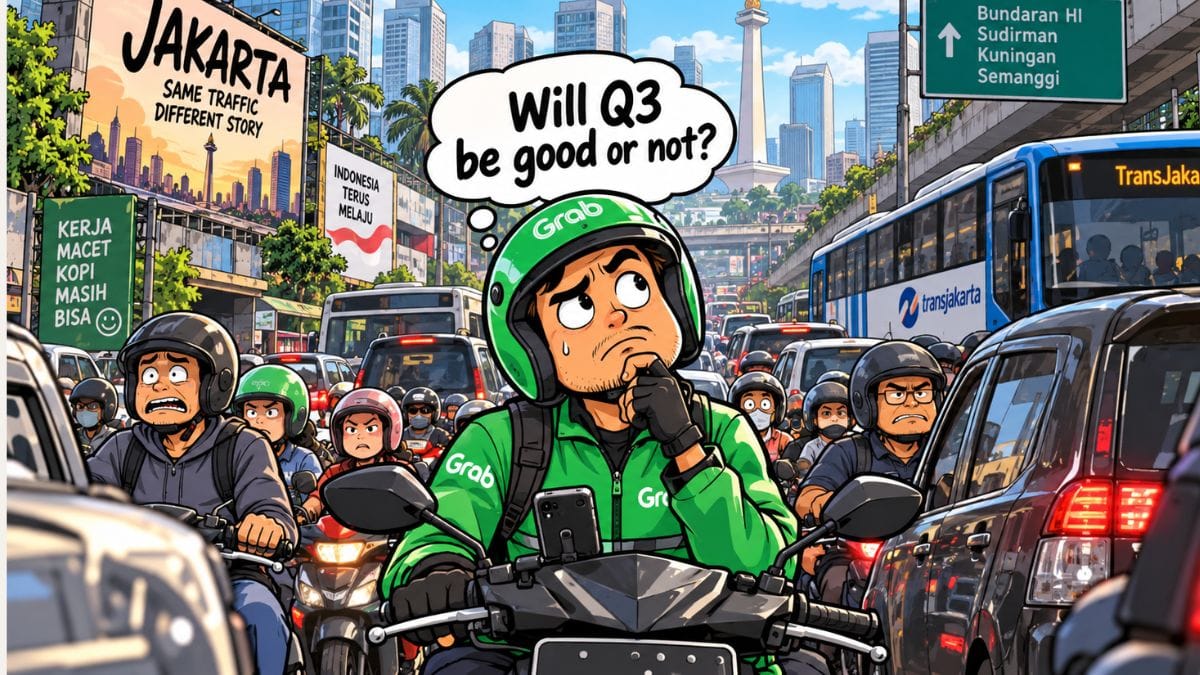
Indonesia’s government has capped the commission that ride-hailing platforms can take from drivers at 8%. GoTo Gojek Tokopedia (IDX: GOTO), the local rival of Grab Holdings (NASDAQ: GRAB), has so far kept its bottom line positive. The question for investors is whether this helps or hurts Grab.
Key Takeaways
- GoTo is absorbing the 8% commission cap. The cap trimmed about 1.5 hundred billion rupiah from GoTo’s Q3 2026 EBITDA, yet the company still posted a net profit of 1.16 trillion rupiah by raising prices, cutting discounts and trimming incentives.
- Grab’s exposure is real but likely priced in. Indonesia is Grab’s third-largest market at 21.2% of revenue, and a GoTo-style hit could mean roughly $15.9 million in quarterly EBITDA pressure. Even so, Grab raised its 2026 revenue and adjusted EBITDA guidance in August.
- Grab looks cheap, with a catch. Its forward EV/EBITDA of 7.6x is below Uber (11x) and Lyft (8x), and financial services (Superbank, Stash) is the key growth driver. A weak Q3 report on November 2 could still hurt the stock.
GoTo stays profitable despite the cap
GoTo has released its third-quarter 2026 results. It reported net profit of 1.16 trillion rupiah, even though the 8% cap has been in effect since July 2026.
The cap still has a cost. Management said it reduced the company’s EBITDA by about 150 billion rupiah over the quarter.
To offset the hit, GoTo adjusted its pricing and discounts. Prices on some affordable transportation services rose, and discounts were scaled back. Management said this happened across the industry, including at competitors. The aim was to restore profit margins.
The numbers show the strategy working so far:
- Incentives fell sharply. On-demand service incentives dropped 19.2% to 1.55 trillion rupiah through September 2026.
- Order volume kept growing. On-demand orders rose 9%, while gross transaction value (GTV) rose only 1%.
Because orders kept growing, GoTo could absorb the drop in revenue per trip.
What it means for Grab
Grab will report its third-quarter 2026 results on November 2, 2026.
Grab is much larger than GoTo, which operates mostly in Indonesia. Grab runs in most Southeast Asian countries, including Malaysia, Singapore, Indonesia, the Philippines, Thailand and Vietnam. Still, Indonesia matters. It is Grab’s third-largest market, at 21.2% of total revenue.
Grab’s Indonesian business has been healthy. Revenue there rose 22.8% to $415 million in the first half of 2026.
For a rough estimate of the impact, assume Grab’s Indonesian mobility gross merchandise value (GMV) is about $664 million per quarter. If the cap cuts EBITDA by 2.4% of GMV, as it did at GoTo, Grab could see EBITDA pressure of about $15.9 million per quarter.
That may already be priced into Grab’s outlook. On August 4, 2026, Grab raised its full-year guidance:
| Metric | Previous guidance | New guidance |
|---|---|---|
| Revenue | $4.04–$4.10 billion | $4.10–$4.15 billion |
| Adjusted EBITDA | $700–$720 million | $720–$740 million |
The new adjusted EBITDA range implies growth of roughly 44% to 48%. Since the cap took effect in July, Grab’s management likely factored the Indonesian pressure into this guidance.
 Surya Rianto
Financial services is a key driver
Grab’s confidence rests largely on its financial services business, which is expected to turn adjusted-EBITDA positive. Two moves support this:
- Superbank (IDX: SUPA): This Indonesian digital bank has been consolidated into Grab’s results since June 2026.
- Stash: Grab is acquiring this U.S.-based digital finance and investing platform. Its results are expected to be consolidated starting in the third quarter of 2026.
Valuation: Grab looks cheap against Uber and Lyft
Grab also looks inexpensive next to its U.S. peers. As of October 29, 2026, its enterprise value to EBITDA (EV/EBITDA) multiples were:
| Company | EV/EBITDA (trailing) | EV/EBITDA (forward) |
|---|---|---|
| Grab | 16.5x | 7.6x |
| Uber | 17.1x | 11x |
| Lyft | 122.5x | 8x |
On forward earnings, Grab is the cheapest of the three.
The bottom line
Grab’s biggest catalysts are the expected improvement in financial services in the second half of 2026 and steady growth in mobility. We see room for the stock to rise ahead of the November 2 earnings report.
The risk is that results come in below expectations. If they do, Grab shares could face significant pressure.
Mikirduit US provides independent financial research and educational content. This article is not personalized investment advice, and investors should conduct their own research before making investment decisions.