
Sana Biotechnology Could Be a Multibagger—or a Major Loss. Here’s the Risk-Reward Setup
Sana Biotechnology offers high-risk, high-reward biotech exposure, with SC451 and SG293 driving the upside while cash burn and dilution remain major risks.

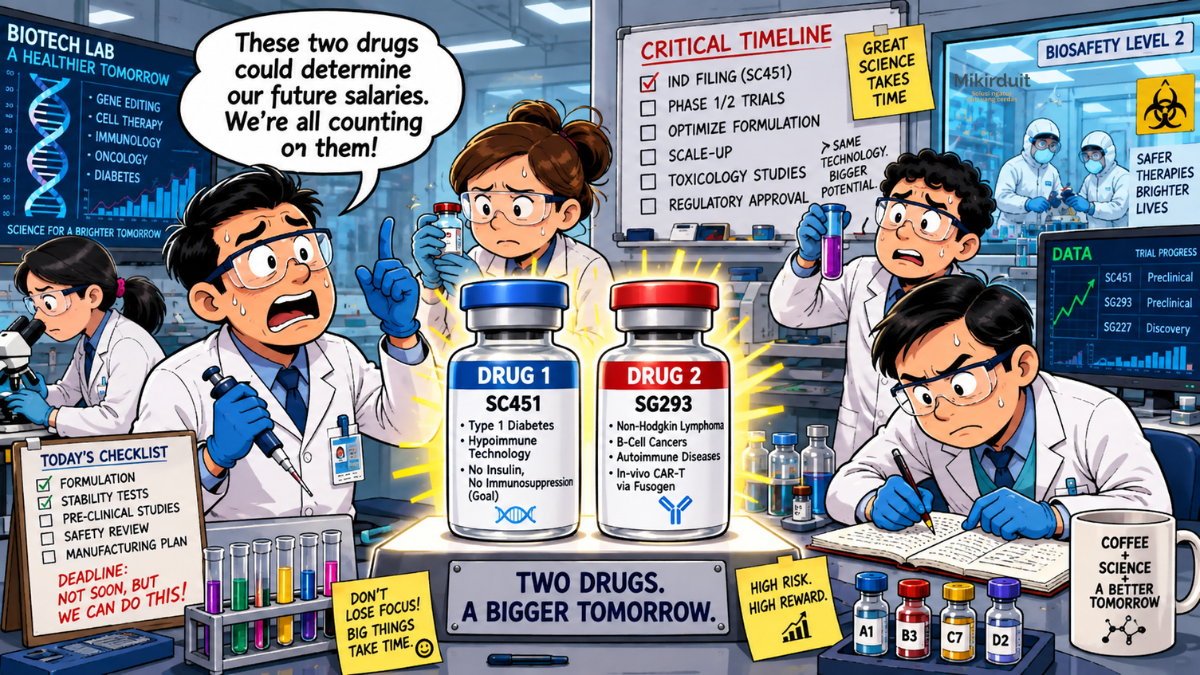
Mikirduit — Sana Biotechnology Inc. (NASDAQ: SANA) is the kind of small-cap biotech stock that can produce enormous returns if its science works—and equally painful losses if it doesn’t.
3 Key Takeaways
- Sana Biotechnology’s biggest upside depends on SC451 and SG293, two early-stage programs that could create substantial value if clinical results are successful.
- SANA’s biggest near-term risk is financing, as limited cash, high R&D spending and remaining ATM capacity could lead to further shareholder dilution.
- The stock offers multibagger potential, but investors should treat it as a speculative biotech position because failure in its key programs could sharply reduce its value.
The company is developing genetically engineered cell therapies for diseases including type 1 diabetes, B-cell-mediated autoimmune disorders and cancer.
That gives SANA a potentially large addressable market.
But unlike a mature healthcare company, Sana doesn’t have an established earnings base investors can use to value the stock. Its future depends primarily on whether a small number of experimental therapies can successfully move through clinical development.
That makes the investment case unusually binary.
At this stage, investors are effectively betting on three things:
the science, the balance sheet and the company’s ability to avoid excessive dilution before its pipeline produces meaningful clinical results.
SC451 Could Be Sana’s Most Important Asset
The first major program to watch is SC451, Sana’s experimental therapy for type 1 diabetes.
SC451 uses the company’s hypoimmune, or HIP, technology, which modifies cells with the goal of helping them evade immune rejection.
The ultimate ambition is significant:
Sana wants to develop cells that could allow people with type 1 diabetes to maintain normal blood-glucose levels without requiring external insulin or chronic immunosuppressive drugs.
That is a highly ambitious target.
But the underlying technology has already produced an encouraging signal.
An investigator-sponsored study involving UP421, which uses the same HIP platform as SC451, showed that transplanted pancreatic islet cells remained alive and functional for 14 months in a patient who wasn’t receiving immunosuppressive therapy.
That doesn’t prove SC451 will succeed.
But it gives the program something many early-stage biotech assets don’t have: human evidence that the core technology may work.
Sana is now targeting an Investigational New Drug application, or IND, for SC451 and expects to move the therapy into a Phase 1/2 trial.
For investors, that makes SC451 one of the company’s most important potential catalysts.
SG293 Is the Second Major Bet
The other program that could define Sana’s future is SG293.
SG293 is being developed for indications including non-Hodgkin lymphoma, B-cell cancers and autoimmune diseases.
The therapy uses an in-vivo CAR-T approach delivered through Sana’s fusogen technology.
Traditional CAR-T therapy can be complex and expensive because a patient’s cells typically need to be collected, engineered outside the body and then reinfused.
Sana’s approach is different.
The goal is to create CAR-T cells directly inside the patient.
If that works, it could potentially simplify treatment and reduce some of the logistical burden associated with conventional CAR-T therapy.
SG293 has shown encouraging results in nonhuman primate studies and is now moving toward first-in-human testing.
That next transition will be critical.
Preclinical results can look impressive, but biotech history is full of therapies that worked in animals and failed once tested in humans.
For SANA investors, SG293 will need to show that the fusogen platform is not only scientifically interesting but clinically viable.
SG227 Depends Heavily on SG293
Sana is also developing SG227, a potential treatment for multiple myeloma.
The program uses in-vivo BCMA CAR-T technology through the same fusogen platform.
Management is targeting clinical testing around mid-2027.
But SG227 shouldn’t be viewed as an entirely independent opportunity.
Its value depends heavily on what Sana learns from SG293.
If SG293 produces encouraging early clinical data, confidence in the broader fusogen platform could increase substantially.
That would improve the probability investors assign to SG227.
If SG293 disappoints, however, the market could discount not only SG293 but SG227 as well.
In other words, these programs are scientifically linked.
One successful study could raise the value of multiple assets.
One failure could do the opposite.
 Surya Rianto
Sana Is Becoming More Concentrated
There is another issue investors need to understand.
Sana has narrowed its pipeline.
The company is increasingly concentrating resources around SC451 and SG293, while programs including SC291 and SC262 have been discontinued.
There is a positive side to that decision.
Early-stage biotech companies have limited capital. Focusing money and management attention on the most promising programs can improve capital efficiency and extend runway.
But concentration also increases risk.
Sana has fewer shots on goal.
If both SC451 and SG293 succeed, investors could see substantial value creation.
If both fail, there may be far less remaining pipeline value to support the company’s valuation.
That makes Sana increasingly dependent on a small number of clinical events.
The Balance Sheet Is the Bigger Near-Term Problem
Even if investors like Sana’s science, the company still has to finance it.
That is where the investment case becomes more difficult.
Sana’s cash balance has fallen to roughly $57.1 million.
At the same time, research-and-development spending totaled approximately $59.4 million in just the first six months of the year.
Management has also warned that its existing capital resources aren’t sufficient to fund planned operations for the next 12 months.
That does not necessarily mean Sana is heading toward bankruptcy.
It means the company needs more money.
And that funding could come from several places:
- additional equity offerings,
- debt,
- strategic partnerships,
- licensing agreements,
- or potentially a broader corporate transaction.
For current shareholders, the most immediate risk is equity issuance.
Dilution Has Already Started
Sana has already been raising money through the stock market.
Its share count increased roughly 12.2% during the first six months of 2026 to approximately 299.3 million shares.
A major reason was the company's at-the-market, or ATM, equity program.
An ATM allows a public company to sell newly issued shares gradually into the market rather than completing one large secondary offering at once.
During the second quarter, Sana sold around 21.6 million shares through the ATM and raised approximately $68.6 million.
The broader facility allows for up to $150 million in equity sales.
After the transactions completed so far, roughly $80 million of remaining capacity appears to be available.
That gives Sana access to additional capital.
It also means investors should assume further dilution remains possible.
And potentially likely.
Why Dilution Matters So Much for SANA
Dilution isn't automatically bad.
If a biotech company raises $100 million and uses that capital to produce successful clinical data that ultimately creates billions of dollars in drug value, existing shareholders can still benefit enormously.
The problem is timing.
If Sana needs to repeatedly issue shares before reaching important clinical milestones, the ownership percentage of existing investors can shrink significantly.
That matters even more for a stock trading at only a few dollars a share.
The lower the stock price, the more shares the company needs to issue to raise the same amount of cash.
That creates one of the biggest risks in the SANA investment case:
weak share prices can lead to more dilution, and more dilution can create additional pressure on the share price.
Mayo Clinic’s Investment Is an Important Signal
One of the more interesting developments around Sana is the involvement of Mayo Clinic.
As of April 2026, Mayo Clinic had purchased approximately 7.5 million Sana shares at $3.33 each, representing an investment of about $25 million.
Mayo also received an option to purchase roughly another 7.5 million shares at the same $3.33 price through the end of August 2026.
If the second tranche is exercised, Sana could receive another approximately:
$25 million in cash.
But again, the capital would come with additional dilution.
Another 7.5 million shares would need to be issued.
Still, Mayo Clinic's participation is notable.
It doesn't guarantee clinical success.
But having a major medical institution willing to commit capital can provide investors with a degree of external validation that is often absent in very early-stage biotech companies.
The Cobalt Biomedicine Deal Creates Another Long-Term Liability
Sana also has a less obvious financial risk tied to its fusogen platform.
The company acquired Cobalt Biomedicine to gain access to fusogen technology.
If that platform ultimately succeeds, Sana could owe former Cobalt stakeholders milestone payments that may reach as much as:
$1 billion.
There is an important irony here.
If fusogen fails, Sana has a scientific problem.
If fusogen succeeds, Sana may eventually have a large financial obligation.
That doesn't mean success would be bad.
A commercially successful platform could be worth far more than the milestone payments.
But it means that not all of the value created by successful fusogen therapies would necessarily accrue directly to current Sana shareholders.
Future payments could require cash, debt financing or additional equity issuance.
That is another reason investors should look beyond the headline clinical opportunity and examine Sana’s full capital structure.
SANA Isn’t a Traditional Valuation Story
Trying to value Sana using conventional metrics such as price-to-earnings or free cash flow doesn't make much sense.
The company is still developing drugs.
There is no mature earnings stream to capitalize.
Instead, the stock should be thought about through a probability-weighted framework.
Investors need to ask:
What is the probability SC451 works?
What is the probability SG293 works?
How much capital will Sana need before those answers become clearer?
And how many additional shares might exist by then?
Those questions matter more than whether the company posts a larger or smaller quarterly loss.
Why the $3 Area Is Interesting
Given those risks, we view the roughly $3-per-share area as an interesting level for investors willing to accept the speculative nature of the stock.
That doesn't mean $3 represents fundamental fair value in the traditional sense.
It means the price begins to provide a more attractive asymmetry if an investor believes the pipeline has a meaningful probability of producing positive clinical results.
We would still keep capital available if the stock falls toward approximately:
$2 a share.
That downside scenario is plausible given Sana's financing needs and the volatility typical of small-cap biotechnology stocks.
Investors should therefore avoid treating any initial purchase as a full position.
Sana Has Two Major Shots on Goal
The simplest way to frame SANA is that the company currently has two major potential catalysts:
SC451
and
SG293.
If one of them produces compelling human clinical data, SANA could rerate dramatically.
If both succeed, the upside could be substantial.
That is where the multibagger potential comes from.
But the inverse is also true.
If both programs fail, the investment case could deteriorate quickly because Sana has increasingly concentrated its pipeline around those programs.
That is why position sizing matters far more here than it might for a diversified large-cap stock.
This is a high-risk, high-reward biotech investment—not a conventional core portfolio holding.
What to Do After a Big Rally
There is another practical point investors should consider.
If Sana reports positive clinical news and the stock jumps sharply, we would be inclined to take at least some profits.
That may sound overly cautious if the data are strong.
But Sana will likely still need additional capital.
A big rally can give management an attractive opportunity to issue new shares at a higher price through its ATM facility or another equity offering.
That would be rational from the company's perspective.
It could also put pressure on the stock after the initial rally.
Mayo Clinic's investment around $3.33 a share provides another useful reference point.
If positive news sends SANA significantly above that level, subsequent equity issuance could eventually pull the stock back toward a more normalized range.
That creates a different trading dynamic from a profitable biotech company with plenty of cash.
Good news can drive the stock higher—and simultaneously improve the company's ability to dilute shareholders.
The Bottom Line
Sana Biotechnology offers exactly the kind of setup that attracts speculative biotech investors.
The upside could be enormous.
SC451 is backed by encouraging human evidence from the HIP platform, while SG293 could potentially validate an entirely new approach to in-vivo CAR-T therapy.
Success in either program could materially change how investors value the company.
But the risks are equally significant.
Sana has limited cash.
Its research spending is substantial.
Management has warned that current funding isn't enough to cover planned operations for the next year.
The company has already increased its share count materially and still has additional ATM capacity available.
And its pipeline is increasingly concentrated around a small number of assets.
That leaves SANA with a highly asymmetric investment profile.
At around $3, the stock may become interesting for investors comfortable with speculative biotech risk.
We would still preserve capital for a potential decline toward $2.
And any position should remain relatively small.
If SC451 or SG293 succeeds, SANA could deliver the kind of return investors look for in small-cap biotech.
If both fail—or if repeated financing significantly dilutes shareholders before the science is proven—the downside could be severe.
That is what makes SANA compelling.
It is also what makes it dangerous.
The numbers are only the beginning.
Every week, Mikirduit US breaks down earnings, valuations, catalysts, and risks across U.S. stocks—so you can see what the market may be missing.
Mikirduit US provides independent financial research and educational content. This article is not personalized investment advice, and investors should conduct their own research before making investment decisions.