Walmart (WMT) vs. McKesson (MCK): Two Defensive Stocks Rising While the S&P 500 Falls
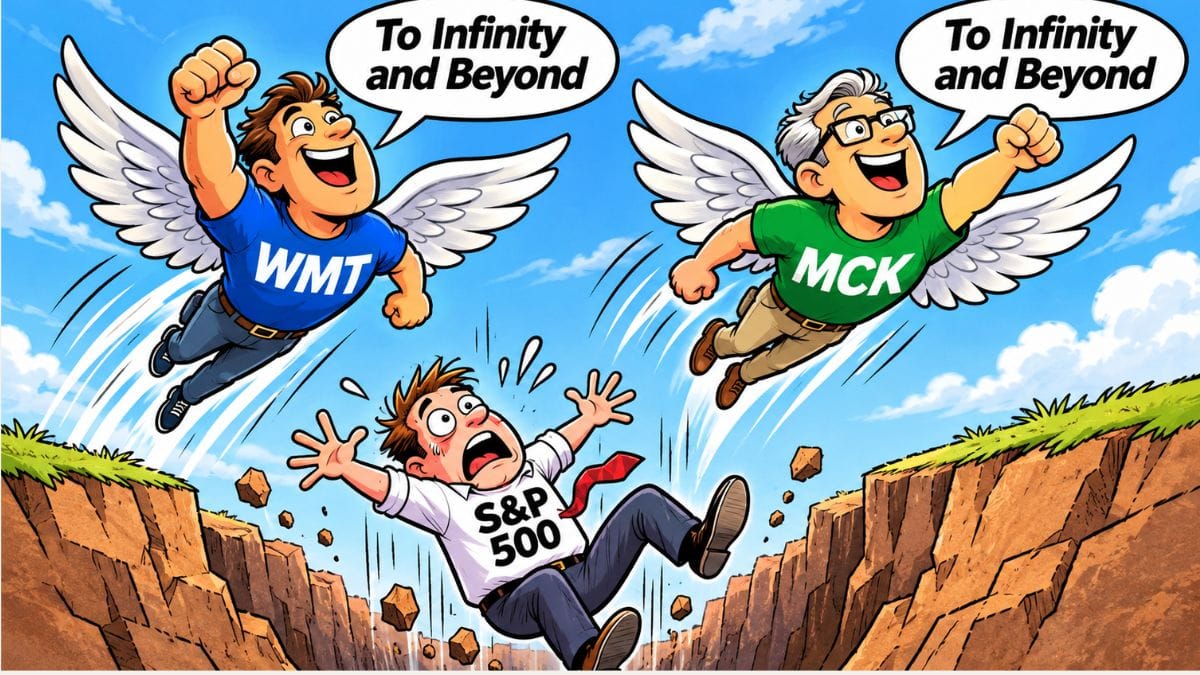
Walmart (WMT) and McKesson (MCK) have both gained while the S&P 500 fell 6.2%. McKesson is growing faster but carries more risk, while Walmart trades at a richer valuation. We compare earnings, guidance, risks and valuation to see how each stock stacks up.

Mikirduit – Defensive stocks are companies whose revenue holds up in weak markets because people keep buying groceries and medicine regardless of the economy. When the broader market sells off, investors often rotate into them.
Key Takeaways
- Both stocks outperformed. Walmart (NYSE: WMT) rose 9.99% to $132.31 per share while the S&P 500 fell 6.2% over the same period. McKesson (NYSE: MCK) gained 8.58% over the past month against the same 6.2% index decline.
- McKesson is growing faster. Its latest-quarter adjusted operating profit rose 13%, versus 5.5% for Walmart.
- McKesson also carries more business risk. Its risks include negative shareholder equity, rising debt, opioid-related litigation liabilities and heavy reliance on GLP-1 drug demand.
- Walmart is the more expensive stock. It trades at 50.3x trailing earnings and 23.1x EV/EBITDA, against 26.5x and 18.1x for McKesson.
- Neither stock looks cheap. Both trade above their five-year averages and rank among the most richly valued names in their peer groups. Based on current valuations, the margin of safety looks thin.
That is the pattern with Walmart and McKesson. Both gained while the S&P 500 declined. So which one is the better opportunity?
Walmart (WMT): Steady Growth, With a Digital Edge
Quarterly performance: solid, not spectacular
Walmart's most recent quarterly results (calendar Q3 2026, which is fiscal Q3 2027 in Walmart's reporting calendar) were respectable rather than exciting:
- Revenue: up 5.2% to $188.8 billion
- Adjusted operating income (excluding non-recurring items): up 5.5% to $7.66 billion
The real story: higher-margin digital businesses
What stands out is where the growth is coming from. It is no longer driven mainly by in-store grocery sales. Walmart's digital and membership businesses are growing much faster:
| Business line | Growth |
|---|---|
| Global e-commerce | +17% |
| U.S. e-commerce | +23% |
| Sam's Club e-commerce | +30% |
| Global advertising | +25% |
| U.S. advertising | +37% |
| Membership fee income | +17% |
Walmart CFO John David Rainey said these higher-margin businesses are a key driver of growth and are contributing more to profit.
Are higher-income shoppers a good sign?
Walmart is also seeing stronger demand from higher-income households. That can be read two ways:
- Positive: Walmart is winning a new customer segment, helped by faster delivery and attractive membership offers.
- Cautionary: Higher-income households may be trading down to save money or preparing for economic uncertainty, which could signal broader pressure on consumer purchasing power.
Delivery speed is a clear competitive advantage. On its November 19, 2026 earnings call, management said Walmart can now reach 96% of U.S. households with delivery in under three hours, and 60% in under 30 minutes.
Raised guidance for fiscal 2027
Expectations of stronger results helped the stock outperform. In November 2026, Walmart raised its fiscal 2027 outlook:
| Metric | New guidance | Previous guidance |
|---|---|---|
| Net sales growth | 4.9%–5.2% | 4%–5% |
| Adjusted operating income growth | 8%–8.6% | 7%–8.5% |
| Adjusted EPS | $2.84–$2.89 | $2.80–$2.87 |
Walmart's key risks
1. Free cash flow is falling. Free cash flow for January–September 2026 dropped 22.8% to $6.82 billion, from $8.83 billion a year earlier. The decline is tied to roughly $4 billion in additional capital spending. This does not point to a liquidity problem. The question is whether investments in automation, technology, fulfillment networks and omnichannel capabilities will pay off in faster growth.
2. Fuel costs and tariff refunds could pressure fiscal 2028. Rainey said higher diesel and transportation costs have added more than $2 billion in expenses this year. Walmart also received about $3 billion in import tariff refunds, part of which it used to keep prices competitive. If diesel stays high while the one-time refund income disappears, fiscal 2028 profit growth could be squeezed. Walmart has not yet issued fiscal 2028 guidance (which falls mostly in calendar 2027).
McKesson (MCK): Faster Growth, Higher Risk
What McKesson does
McKesson is a large, thin-margin healthcare distributor. Beyond distribution, it has built businesses around oncology care, specialty drugs, clinical research and pharmacy technology.
Quarterly performance
In its latest results (fiscal Q2 2027, McKesson's reporting calendar):
- Adjusted operating profit: up 13% to $1.85 billion
- Revenue: up 8% to $110 billion
- North American Pharmaceutical segment (its largest business): operating profit up 22% to $1.04 billion on just 6% revenue growth
- Segment margin: rose to 1.14% from 0.98% a year earlier
What's driving the profit growth
- Specialty drug distribution. CFO Kenny Cheung said growth in specialty drugs for health systems and strategic accounts is the main profit driver. Management did not disclose how specialty margins compare with other categories.
- Lower drug list prices. Declines in wholesale acquisition cost (WAC) reduced segment revenue growth by about 4 percentage points but did not hurt operating profit. Because distributor profit per unit can stay the same when prices fall, the margin percentage rises.
- The GLP-1 boom. Demand for GLP-1 drugs is lifting distribution volume. The source data states GLP-1 products contributed 67.6% of the distribution segment's revenue; verify that exact figure against McKesson's filing before publishing.
- Technology efficiency. CEO Brian Tyler said years of investment in warehouse automation, robotics, process automation, IT systems and AI are starting to pay off.
 Surya Rianto
Raised outlook
Management raised its segment revenue growth target to 5%–9% (from 4%–8%) and its adjusted operating profit growth target to 14%–18% (from 5.5%–9.5%). It cited rising prescription volumes, strong specialty and GLP-1 demand, procurement and distribution efficiencies, new customers and contract renewals, including a CVS Health extension through June 2032. Is Hyperliquid Strategies (PURR) Stock Cheap? A NAV Breakdown After a 43% Drop
McKesson's key risks
- GLP-1 dependence. A slowdown in demand for these drugs would hit growth.
- U.S. healthcare policy. Possible changes include tighter Medicaid funding, Medicare changes, drug price negotiation, revisions to the 340B program, pharmacy distribution reform and direct-to-consumer drug sales.
- Balance sheet. Shareholders' equity is negative $3.95 billion. Interest-bearing debt rose 41.1% to $9.21 billion, and management expects 2027 interest expense of $380–$420 million, up 65%–83% from 2026. Still, interest coverage is a comfortable 15.28x.
- Litigation. McKesson has a history of opioid distribution lawsuits in the U.S. Long-term litigation liabilities reached $4.56 billion as of September 2026. They need not be paid all at once but limit cash flow flexibility.
- Customer concentration. Large customers such as CVS Health could seek lower compensation, change procurement or reduce volumes.
- Medical-Surgical Solutions spin-off. Short term, it could bring transaction costs, a changed debt structure and lost consolidated profit. Over the medium term, the outcome depends on how the separation is structured and what value shareholders receive.
Valuation: How Expensive Are WMT and MCK?
Versus their own history
| Stock | P/E (5-yr avg) | P/E (latest) | EV/EBITDA (avg) | EV/EBITDA (latest) | P/B (avg) |
|---|---|---|---|---|---|
| Walmart (WMT) | 40.1x | 50.3x (Oct 31, 2026) | 16.1x | 23.1x (Oct 31, 2026) | 6.9x |
| McKesson (MCK) | 25.1x | 26.5x (Sep 30, 2026) | 14.7x | 18.1x (Sep 30, 2026) | N/M* |
*McKesson's price-to-book ratio is not meaningful because its equity is negative, so P/E and EV/EBITDA are more useful.
Versus peers
| Group | Stock | P/E | EV/EBITDA |
|---|---|---|---|
| Retail | Costco (COST) | 52.4x | 33.3x |
| Retail | Kroger (KR) | 38.4x | 7.9x |
| Retail | Dollar General (DG) | 18.0x | 12.5x |
| Retail | Dollar Tree (DLTR) | 18.1x | 12.5x |
| Retail | Target (TGT) | 16.2x | 10.6x |
| Healthcare | Cardinal Health (CAH) | 35.6x | 15.6x |
| Healthcare | Henry Schein (HSIC) | 23.0x | 13.1x |
| Healthcare | Centene (CNC) | 21.8x | 2.6x |
| Healthcare | HCA Healthcare (HCA) | 14.9x | 9.8x |
Walmart's 50.3x P/E is second only to Costco among the retailers shown. McKesson sits second in the healthcare group on P/E (behind Cardinal Health) and first on EV/EBITDA. Both are above their own historical averages and in the top tier of their peer groups.
Bottom Line: WMT vs. MCK
- Growth: McKesson is growing faster, and management has raised its targets.
- Risk: McKesson's risks, including debt, litigation, regulation and GLP-1 dependence, are more significant than Walmart's.
- Valuation: Walmart is more expensive on both P/E and EV/EBITDA, but neither is cheap.
- Our view: Both stocks have outperformed in a falling market, but with valuations well above historical averages, the current entry points offer limited margin of safety. Investors may prefer to wait for a meaningful pullback.
Frequently Asked Questions
Is Walmart stock a good defensive investment?
Walmart has outperformed during the recent market decline, supported by steady sales, growing digital and advertising income, and raised fiscal 2027 guidance. However, its 50.3x P/E is well above its five-year average of 40.1x, and free cash flow has declined.
Is McKesson stock overvalued?
McKesson's 26.5x P/E is only modestly above its 25.1x five-year average, and it is cheaper than Walmart. But its EV/EBITDA of 18.1x is above its 14.7x average, and it ranks near the top of its healthcare peers.
Which is riskier, WMT or MCK?
Based on the factors above, McKesson carries more business-specific risk: negative equity, rising debt, opioid-related litigation liabilities, customer concentration and regulatory exposure. Walmart's main risks are falling free cash flow and potential fuel-cost and tariff headwinds in fiscal 2028.
Why are WMT and MCK rising when the S&P 500 is falling?
Investors often favor companies selling essentials, groceries and medicine, during market weakness. Both companies also raised their outlooks, which supported their share prices.
Mikirduit US provides independent financial research and educational content. This article is not personalized investment advice, and investors should conduct their own research before making investment decisions.