Democrats’ Midterm Win Could Help UnitedHealth and Centene, but Policy Is Only Part of the Story
Democrats’ midterm win could give UnitedHealth and Centene a boost through ACA subsidies and Medicaid changes, but policy is only part of the story. Here is how each insurer performed in Q3, what could go wrong, and which stock looks more appealing.

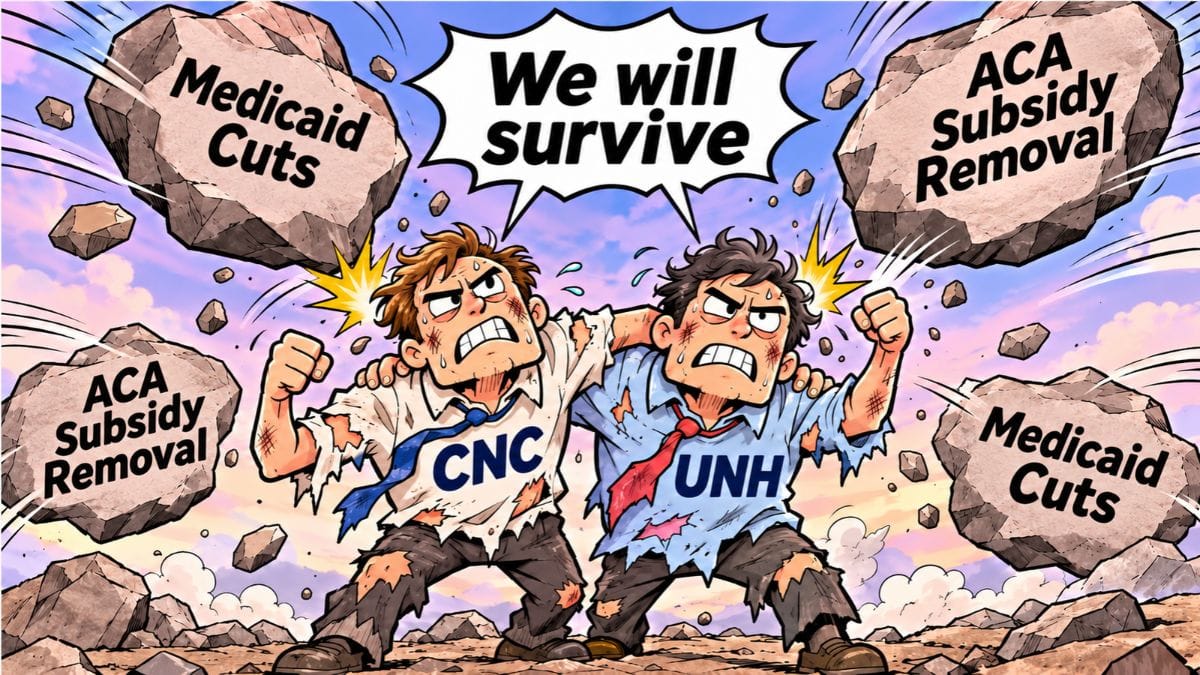
Mikirduit – Two health insurers, UnitedHealth Group (NYSE: UNH) and Centene Corporation (NYSE: CNC), could benefit if Democrats take control of both the House and the Senate in the 2026 midterm elections. Health care costs are a top Democratic priority, and several of their proposals would affect how many Americans stay insured. Here is what a Democratic Congress could change, how each company is performing, and why investors should not treat politics as the whole story.
Key Takeaways
- A Democratic Congress could help UnitedHealth (UNH) and Centene (CNC) by restoring enhanced ACA subsidies and easing Medicaid rules, but a veto, the filibuster and timing make passage uncertain.
- Centene is more exposed to ACA and Medicaid policy, with Marketplace enrollment down 41.6% year over year. UnitedHealth has more diversified income, and both are already working on their own profit recovery.
- More members do not automatically mean more profit. Investors should watch enrollment, health benefits ratios and margins, not just headlines from Washington.
Note: This article assumes the midterm outcome described above. Please verify final results with official sources.
What Democrats Want on Health Care
Democrats have said they want to pursue three goals:
- Restore the enhanced Affordable Care Act (ACA) subsidies. The enhanced premium tax credits expired at the end of 2025. They had helped millions of Americans afford coverage on the ACA Marketplace, and Democrats want to bring them back so people are not hit with steep premium increases.
- Roll back or ease recent Medicaid restrictions. The 2025 budget reconciliation law tightened several Medicaid rules.
- Strengthen oversight of drug prices and health care costs.
Before the 2025 law, there was no general federal work requirement for adults in the Medicaid expansion group, though some states had tried their own. Eligibility was usually reviewed every 12 months. The new law changed both. Some adults ages 19 to 64 must now complete at least 80 hours per month of work, education, job training, or community service, with some exceptions. Eligibility checks for certain groups will also happen every six months instead of annually.
These rules generally take effect on January 1, 2027, though some states may start earlier. That means this year’s drop in Medicaid enrollment is not yet a full result of the new requirements. The bigger effect could come in 2027 and beyond.
If Democrats succeed, both insurers could see their enrollment stabilize. Both have already faced shrinking membership in government-backed plans this year.
Why Centene Is More Exposed
Centene is among the companies most affected by changes to the ACA Marketplace. As of September 2026:
- Marketplace membership fell about 41.6% year over year, to 3.40 million.
- Medicaid membership fell about 6.4%, to 11.90 million.
The Marketplace decline reflects the end of the enhanced subsidies, customers’ reduced ability to pay premiums, and the company’s own decision to adjust its insurance portfolio. UnitedHealth is also seeing membership pressure in Medicaid and Medicare, driven by contract changes, market shifts, and its push to improve profitability. But Centene is clearly more sensitive to ACA and Medicaid policy.
Related reading: Long-Term Treasury ETFs or Bitcoin After the Election Selloff? What Aggressive Investors Should Weigh
A Caution: More Members Does Not Automatically Mean More Profit
Insurers must pay medical claims for every member they cover. If medical costs grow faster than the premiums collected, margins shrink, even with more customers. Restored subsidies and looser Medicaid rules could help keep enrollment steady, but profits will still depend on how well each company manages premiums, medical costs, and operations.
How the Companies Performed in Q3 2026
Centene: Operational recovery, with pressure on profits
- Net loss attributable to the company was $71 million for the quarter. For the first nine months, net income was about $2.56 billion.
- That nine-month figure looks much better than last year, but the comparison is skewed. In Q3 2025, Centene booked a goodwill impairment of about $6.72 billion. Most of the year-over-year swing in GAAP earnings comes from that one-time charge not recurring.
- The core business did improve. Adjusted net earnings were about $290 million, up roughly 18.4% from $245 million a year earlier.
- Its adjusted SG&A expense ratio improved from 7.0% to 6.5%.
- Its health benefits ratio, the share of premiums spent on medical care, was 92.7%, unchanged from a year earlier.
- Restructuring costs weighed on results: about $276 million in severance and $35 million in vendor costs tied to company optimization. These are expenses that reduced GAAP earnings, not one-time gains that inflated them.
Centene raised its 2026 adjusted EPS outlook to more than $5.20 per share. It has not yet issued firm 2027 guidance.
 Surya Rianto

UnitedHealth: A clearer margin recovery
- Revenue was $112.7 billion, with operating earnings of about $6.6 billion.
- Adjusted EPS was $4.69. The company raised its 2026 adjusted EPS outlook to at least $20.50.
- The improvement came from benefit design changes, disciplined pricing, administrative efficiency, and medical cost control, not just membership growth. UnitedHealth has also deliberately pulled back from some products and regions that were less profitable.
Their 2027 Plans Do Not Depend on Washington
UnitedHealth expects 2027 adjusted EPS growth at the low end of its long-term target of 13% to 16%. Its plan includes:
- Medicare Advantage: reshaping its mix of plans, including HMOs, D-SNPs (for people eligible for both Medicare and Medicaid), and C-SNPs (for people with certain chronic conditions), while trimming some less profitable PPO plans.
- Optum Health: pulling back from uneconomic markets and improving cost management. Optum Health’s operating margin rose to about 3.2% in Q3, from 0.2% a year earlier.
Centene is working to make its Medicare Advantage business profitable in 2027, even if that means a smaller membership as it focuses on better markets and products. In its Medicare Part D prescription drug plan business, it expects a pretax margin of about 3% in 2026. In 2027 it expects more members and subsidy revenue, but less profit per dollar of revenue. It has also cut its workforce from about 61,100 at the end of 2025 to 53,900 in Q3 2026, a reduction of roughly 7,200 people, through automation and a simpler organization.
Which Stock Looks More Appealing?
- UnitedHealth has more diversified income through UnitedHealthcare and Optum, giving it more ways to improve profits without relying on ACA or Medicaid changes. Its EV/EBITDA multiple is about 12.3x, versus a five-year average of about 14x.
- Centene carries more risk because of its heavier exposure to Medicaid and the ACA Marketplace. Its EV/EBITDA is about 2.9x, versus a five-year average of about 4.2x, a deeper discount than UnitedHealth’s. Its price-to-book ratio is about 1.5x, slightly above its five-year average of 1.4x. That discount reflects real risks: falling enrollment, medical cost pressure, and the question of whether earnings can be sustained.
EV/EBITDA is not the only measure that matters for insurers. Investors should also look at adjusted price-to-earnings, price-to-book, return on equity, and earnings quality. Weighing business risk and income diversification, this analysis leans toward UnitedHealth. Centene is better viewed as a recovery play, with more upside if both its turnaround and policy support go well, and more risk if they do not. Neither stock is obviously cheap once all the risks are considered.
How Likely Is It That Democrats Deliver?
Winning Congress does not guarantee the agenda passes. President Trump still holds veto power, and most legislation in the Senate faces the filibuster, which generally takes 60 votes to overcome. Democrats would need broader support or a deal with the administration. Three scenarios are worth watching:
- A deal before the end of 2026. If the current Congress reaches a compromise, enhanced ACA subsidies could return in 2027. This would require a fast political agreement and is not automatic.
- Action after the new Congress starts in January 2027. Democrats could push revisions, but would still face procedural hurdles and possible resistance from the president. If a compromise passes, effects could appear in 2027 or later, depending on effective dates. A new law could make some provisions retroactive, but investors should not assume that until it passes.
- Delay until 2028, or no change at all. This could happen if Democrats lack Senate support or the president rejects the proposals. Enrollment would then depend on the economy, households’ ability to pay premiums, rules already in place, and each company’s own strategy.
Not every Democratic health care proposal helps insurers. Tighter oversight of costs, insurer practices, or profit margins could create new risks.
The Bottom Line
The election result is best seen as a possible extra catalyst, not the foundation of an investment case. Both companies are already working to restore profitability on their own.
For investors seeking a fundamental recovery with more diversified revenue, UnitedHealth appears the more attractive of the two. Centene is more sensitive to ACA subsidies and Medicaid rules, so its recovery could be stronger if policy changes go its way, but its risks are greater if membership keeps falling or medical costs stay elevated.
Beyond the politics in Congress, investors should track:
- Membership trends
- Health benefits ratios
- Operating margins
- Whether each company can hit its 2027 earnings goals
Mikirduit US provides independent financial research and educational content. This article is not personalized investment advice, and investors should conduct their own research before making investment decisions.