
First Solar Could Be a Major Winner From New U.S. Solar Tariffs
First Solar could benefit from new U.S. solar tariffs, but investors still need to watch pricing, policy support, backlog trends and legal risks.

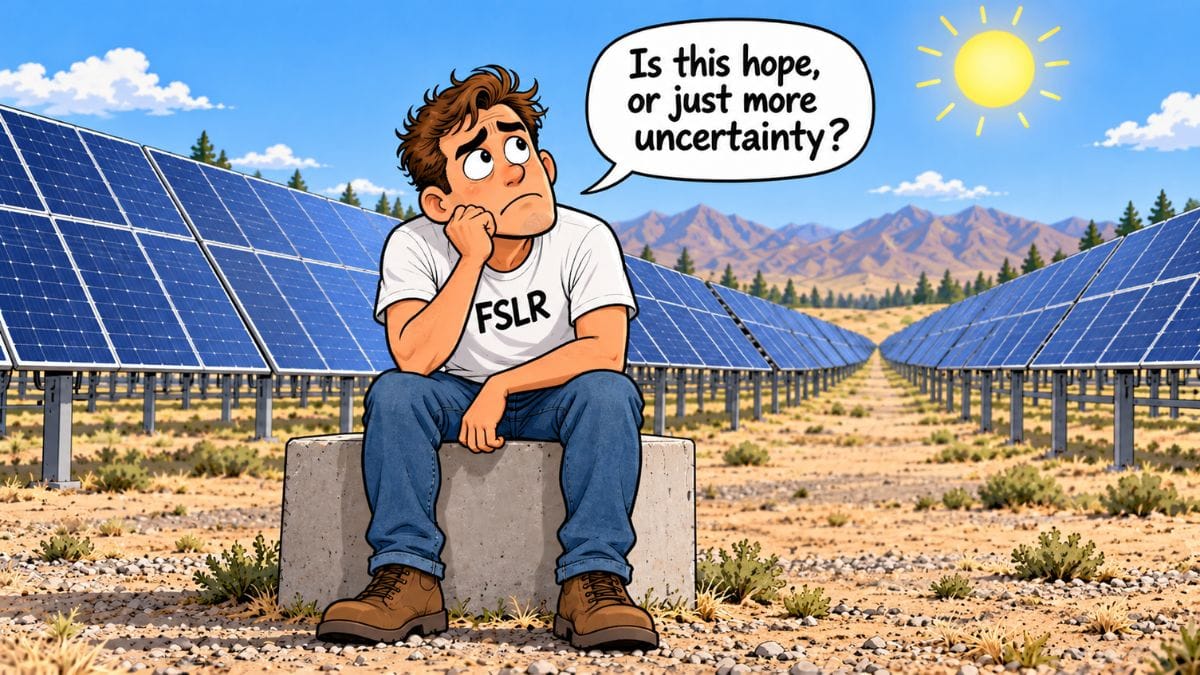
Mikirduit — The U.S. Commerce Department is moving toward imposing steep duties on imports of solar cells and panels from India, Indonesia and Laos. One U.S.-listed stock could emerge as a notable beneficiary: First Solar Inc. (NASDAQ: FSLR).
3 Key Takeaways
- New U.S. anti-dumping and countervailing duties on solar imports from India, Indonesia and Laos could improve First Solar’s pricing power by making imported crystalline-silicon modules less competitive.
- First Solar’s 45.1 GW backlog and largely committed U.S. manufacturing capacity through 2028 provide strong revenue visibility, although its reported margins are heavily supported by Section 45X manufacturing credits.
- The biggest catalysts and risks now center on the Oct. 14 ITC decision, future U.S. trade policy, backlog replacement, and whether First Solar can sustain U.S. booking prices near current levels.
Commerce has assigned final anti-dumping margins of 123% for Indian producers, 94.36% for Indonesian producers and 65.43% for producers in Laos.
The countries would also face countervailing duties, with rates of roughly 126% for India, 73.2% to 173% for Indonesia and 82% to 153% for Laos.
The U.S. International Trade Commission is scheduled to issue its final injury determination on Oct. 14, 2026. The commission will decide whether imports from those countries have materially injured, or threaten to injure, U.S. solar manufacturers.
If the ITC votes in favor of the case, Commerce is expected to issue final duty orders in November.
The dispute marks another chapter in Washington’s long-running effort to curb imports of low-cost solar products.
The U.S. first imposed anti-dumping and anti-subsidy duties on Chinese solar products in 2012. That helped push Chinese manufacturers to shift portions of their supply chains and manufacturing capacity into other Asian countries.
The latest case is significant because imports from India, Indonesia and Laos are not small.
Based on Commerce data for 2024, the U.S. imported roughly 2.3 gigawatts of solar products from India, 1.8 GW from Indonesia and 1.91 GW from Laos.
That raises a key question for investors: Why could First Solar be one of the biggest beneficiaries?
How Much Could First Solar Gain From the New Trade Barriers?
The most important impact may not be a sudden jump in shipment volume.
Instead, the new duties could reduce the pressure on First Solar to cut its average selling price.
Consider a simple sensitivity analysis.
If First Solar were able to preserve its average selling price by just one cent per watt, the impact could amount to roughly $150 million in additional revenue, depending on shipment volumes.
The math works in both directions. Small changes in price per watt become meaningful when multiplied across billions of watts of annual shipments.
First Solar also has another important advantage: its technology is fundamentally different from most imported solar products targeted by the case.
The company does not primarily rely on conventional crystalline-silicon photovoltaic cells and modules. Instead, First Solar manufactures thin-film modules based on cadmium telluride, or CdTe.
That distinction matters because the current trade investigation is focused on imports of crystalline-silicon photovoltaic cells and modules.
If tariffs push up the price of imported crystalline-silicon panels, First Solar could maintain a more competitive relative selling price without having to cut its own pricing aggressively.
There is, however, a downside to higher solar-panel prices in the U.S.
More expensive modules can improve economics for domestic manufacturers such as First Solar, but they can also weaken project returns for solar developers. If project costs rise enough, some installations could be delayed or canceled.
First Solar is relatively insulated from that risk because it already has a large contracted backlog. The company is not solely dependent on selling modules into the spot market.
The potential impact therefore appears different across time horizons.
In the short term, the Oct. 14 ITC decision and potential implementation later this year are likely to act primarily as a market catalyst.
The bigger fundamental effects may become more visible in 2027 and 2028, particularly through pricing and new contract economics.
 Surya Rianto
What Investors Should Watch in First Solar
First Solar’s latest earnings appear strong at first glance, but several details require closer attention.
Revenue Fell Even as Shipment Volume Increased
First Solar’s module sales volume increased 5.3% to 3.7 GW, while revenue declined.
One reason was the comparison with contract-termination-related revenue that had been recognized previously but did not recur after the contracts were terminated.
The issue is linked to agreements with BP Solar Holding and Lightsource Renewable Energy Trading.
Those contracts were terminated in 2025 and represented roughly 6.6 GW of backlog worth about $1.9 billion.
The company has also faced pressure on its average selling price because of product mix.
Bookings in India totaled about 1.1 GW at roughly $0.20 per watt, compared with U.S. bookings of around $0.36 per watt.
That means stronger shipment volume does not necessarily translate into equally strong revenue growth if a larger portion of sales comes from lower-priced markets.
A 57% Gross Margin Looks Impressive, but It Needs Context
First Solar’s reported gross margin is exceptionally high, but not simply because the company earns unusually large manufacturing margins on every panel it sells.
Government incentives are an important contributor.
In the second quarter of 2026, First Solar generated about $1.056 billion of revenue. Cost of sales was roughly $451 million, leaving around $605 million in gross profit and a gross margin of about 57%.
A major factor behind those economics is the U.S. government’s Section 45X advanced manufacturing production credit.
For qualifying modules manufactured in the U.S., First Solar estimates the benefit can reach roughly $0.17 per watt.
Importantly, that incentive is not recorded as additional revenue.
Instead, it reduces cost of sales.
That accounting treatment makes First Solar’s reported gross margin substantially stronger.
Investors therefore should not interpret the 57% gross margin as purely the result of manufacturing efficiency and product pricing. It reflects a combination of operational performance and U.S. industrial-policy support.
A Large Backlog Provides Revenue Visibility
One of First Solar’s biggest strengths is its backlog.
The company had about 45.1 GW of contracted orders worth $13.6 billion, with deliveries extending through 2030.
That gives First Solar considerably more forward revenue visibility than many panel manufacturers that depend heavily on spot-market pricing.
There is one caveat.
Backlog has declined from 50.1 GW to 45.1 GW.
That is not automatically a negative signal because backlog naturally falls as First Solar ships modules to customers.
What matters is whether new bookings are replacing the orders being delivered.
The company has continued to secure new U.S. business, including around 1.9 GW of bookings at approximately $0.36 per watt.
In addition, First Solar’s U.S. manufacturing capacity is already largely committed through 2028.
That reduces pressure on management to chase lower-margin contracts simply to keep factories busy.
There may also be additional value embedded in the existing backlog.
Around 21.6 GW of contracted volume includes pricing mechanisms that could increase revenue if First Solar achieves certain future technology improvements.
Those adjustments could generate as much as $500 million in incremental revenue, with most of that potential concentrated in 2027 and 2028.
A Legal Overhang Remains
First Solar also faces a non-operating risk: shareholder litigation.
A group of investors has alleged that management failed to adequately disclose how tariff-policy changes and lower manufacturing activity in Malaysia and Vietnam could affect the company’s 2026 performance.
The litigation is ongoing and does not mean First Solar has been found liable.
The company has said it intends to defend itself against the allegations.
For now, the case is better viewed as a legal and governance risk than as an issue that directly changes the company’s operating fundamentals.
That assessment could change if the litigation eventually produces evidence showing that management materially misled investors.
Valuation: First Solar Screens Cheaper Than Several Solar Peers
We compared First Solar with Enphase Energy Inc. (NASDAQ: ENPH), Canadian Solar Inc. (NASDAQ: CSIQ), Sunrun Inc. (NASDAQ: RUN), Nextpower Inc. (NASDAQ: NXT) and SolarEdge Technologies Inc. (NASDAQ: SEDG).
On an enterprise-value-to-Ebitda basis, First Solar currently trades at roughly 11 times, compared with approximately:
- Canadian Solar: 70 times
- Sunrun: 196 times
- Enphase Energy: 33.6 times
- Nextpower: 15.7 times
- SolarEdge: negative 14.4 times
Historical comparisons using EV/Ebitda are less useful for First Solar because its long-term average has been distorted by periods of negative Ebitda.
Price-to-book may offer another perspective.
First Solar currently trades at about 2.1 times book value, below its five-year average of roughly 2.5 times.
A discounted-cash-flow estimate places fair value at around $261 per share.
Compared with a share price of approximately $201 as of Sept. 17, 2026, that implies about 30.2% upside under those assumptions.
That estimate, however, remains highly sensitive to policy, pricing and manufacturing assumptions.
The Risks Still Matter
One of First Solar’s biggest operational risks is underutilization at its manufacturing facilities in Vietnam and Malaysia.
Earlier tariff uncertainty in the U.S. forced the company to rethink how aggressively those plants should operate.
Management had previously estimated that broad U.S. import tariffs could create roughly $125 million to $135 million in additional costs during 2026.
Those concerns were tied to broader reciprocal-tariff policy rather than the solar-specific anti-dumping case now targeting India, Indonesia and Laos.
The reciprocal-tariff framework was later rolled back, reducing that particular pressure.
There is also a near-term technical risk for the stock.
If the ITC rules on Oct. 14 that the new anti-dumping measures are not warranted, investors could unwind some of the trade-policy premium currently associated with First Solar.
The longer-term investment case therefore rests on more than tariffs alone.
First Solar still needs to execute on manufacturing, sustain attractive pricing, replenish its backlog and maintain the policy advantages that currently support its unusually strong margins.
But if the U.S. continues raising barriers against imported crystalline-silicon solar products, First Solar’s combination of domestic manufacturing, CdTe technology and a multiyear backlog could become increasingly valuable.
The numbers are only the beginning.
Every week, Mikirduit US breaks down earnings, valuations, catalysts, and risks across U.S. stocks—so you can see what the market may be missing.
Mikirduit US provides independent financial research and educational content. This article is not personalized investment advice, and investors should conduct their own research before making investment decisions.