TSLA vs SPCX: Which Looks More Attractive Amid Merger Talks?
TSLA and SPCX are in early merger talks with no binding deal yet. This article covers the shareholder vote, regulatory hurdles and valuation gap, then compares which stock looks more attractive on merger momentum. Educational analysis, not investment advice.

Mikirduit – At first glance, rockets and satellites have little to do with electric vehicles. The case for combining SPCX and TSLA rests mostly on artificial intelligence and shared infrastructure. The main areas of overlap are:
- AI software. Integrating Grok, which sits at SPCX, with TSLA products to develop more advanced AI software.
- Chip design. Optimizing chips for vehicles, robots and data centers.
- Terafab. Semiconductor production infrastructure that could serve the chip needs of both companies.
- Robotics. Speeding up development of the Optimus robot.
- Orbital infrastructure. Moving large payloads to orbit and building orbital constellations, which could support computing infrastructure in orbit. The source material calls this area "Starmind".
- Connectivity. Using Starlink for vehicles and robots.
Capital spending and computing capacity
Both companies need a great deal of capital. SPCX projects 2026 capital spending of US$83.1 billion to US$88.1 billion, while TSLA's is about US$13.01 billion. A merger could help them avoid building the same infrastructure twice. For example, if TSLA needs new computing facilities, it could use available SPCX capacity and focus on applying that compute to autonomous driving and robotics.
Metric | SPCX | TSLA |
|---|---|---|
2026 capital spending | US$83.1B to US$88.1B (projected) | About US$13.01B |
AI compute, as of September 2026 | 1.7 GW | More than 225 MW |
AI compute target, end of 2026 | 2.5 to 3 GW | About 400 MW |
AI compute target, end of 2027 | About 13 GW | Not stated |
These are company targets, not guarantees. Buying at a larger scale could also strengthen negotiating power with suppliers of GPUs, cooling equipment, battery networks and chips.
Terafab: the clearest shared project
As of November 12, 2026, SPCX and TSLA already have a joint venture for chip manufacturing called Terafab. The first test chips are targeted for May to June 2027, with production from the third quarter of 2028. For TSLA, the chips would support vehicles, robotics and autonomy models. For SPCX, they could serve GPU cloud, model training, Grok inference, AI processing and satellite chips.
Where the Merger Stands Today
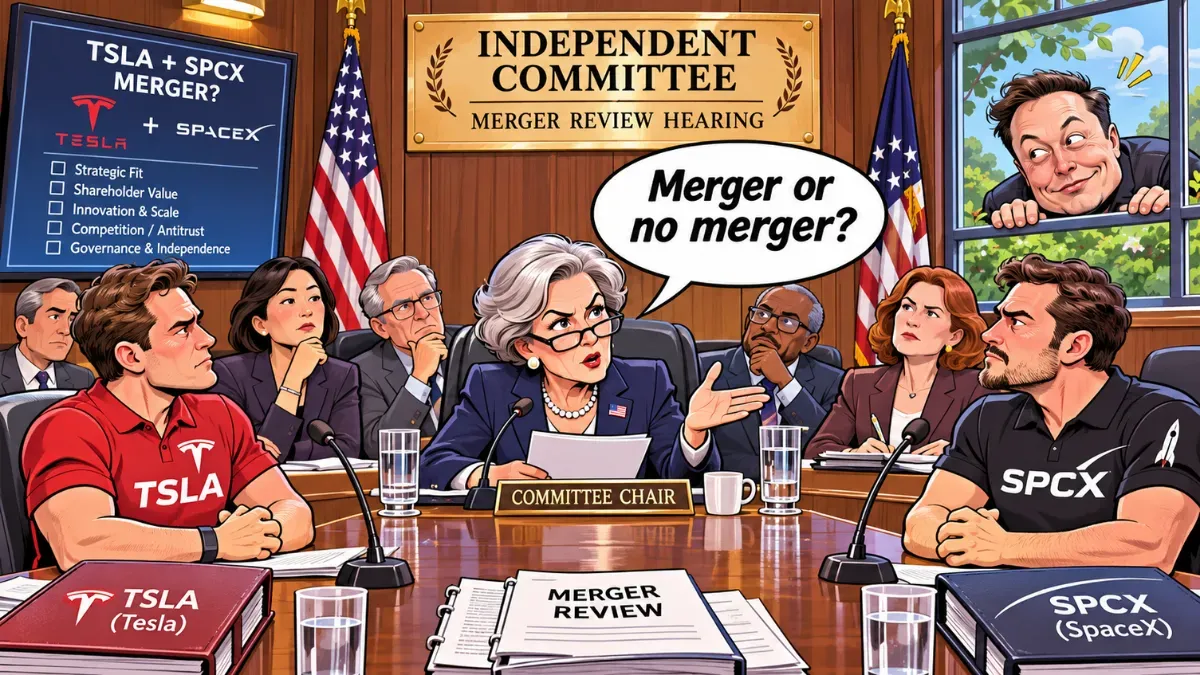
The proposed combination of SPCX and TSLA is still at an early stage: the two companies are in evaluation and negotiation through independent special committees. Neither has announced a binding merger agreement.
The topic first surfaced on SPCX's earnings call on October 20, 2026, when Deutsche Bank analyst Edison Yu asked Elon Musk about a possible merger. Musk said both companies had formed special committees of independent directors at shareholders' request. He does not sit on either committee because of his conflict of interest in both stocks.
TSLA already owned about US$2 billion of SPCX stock in the first quarter of 2026. Given that stake, we see a possibility that TSLA becomes the final surviving entity. This is an analytical view, not a confirmed deal structure.
An update dated November 12, 2026 said negotiations had made progress. It pointed to a possible announcement between December 2026 and early 2027. Even then, talks would only have cleared the independent-committee stage, and about five steps would remain:
- Due diligence and negotiation of the deal structure (still under discussion).
- A definitive merger agreement.
- Shareholder approval.
- Regulatory review and conditions.
- Closing and the start of integration.
Because of these steps, the whole process could take one to two years.
The Main Hurdles: Shareholders and Regulators
A high shareholder approval bar
TSLA needs approval from at least 50% of all its outstanding shares, not just 50% of the shares that vote. In practice, that means about 2 billion of TSLA's roughly 4 billion shares. Low turnout therefore works against the deal, because every share that does not vote counts the same as a vote against. Anthropic IPO (ANT): What It Could Mean for U.S. Stocks and How Newly Listed Shares Have Behaved
Multiple regulators
Several authorities are likely to review the transaction, and each can extend the timeline.
- Antitrust (FTC and DOJ). Reviewers may ask whether the combination would limit competition in AI computing, satellite communications, autonomous vehicles or certain technology infrastructure. This review alone could add significant time.
- National security and defense contracts. SPCX holds U.S. government contracts for national security launches and Starshield. Any change in ownership or control could draw scrutiny.
- China exposure. TSLA has manufacturing operations and business ties in China. Regulators may worry that a merger could make it harder to oversee defense-related technology and information.
One point needs care. TSLA's presence in China does not automatically trigger a CFIUS review, and it does not mean the deal will be blocked. Jurisdiction and conditions will depend on the ownership structure, who controls which assets, and which activities are affected. Until a structure is published, any claim about the outcome is speculation.
 Surya Rianto
Price Action and Valuation
Both stocks have pulled back, but they sit in very different valuation situations.
Metric | TSLA | SPCX |
|---|---|---|
Price change | -14.76% (May 11 to Nov 16, 2026) | -19.92% (Oct 7 to Nov 16, 2026) |
EV/EBITDA | 149x vs. 5-year average of 83.1x | No historical average available |
Valuation context | Above its own 5-year norm | IPO in June 2026, still in price formation |
TSLA. At 149x EV/EBITDA, TSLA trades well above its five-year average of 83.1x. A premium multiple leaves less room for disappointment, so deal delays or unfavorable terms could weigh on the stock.
SPCX. We did not assess SPCX against its own history, because it listed only in June 2026. A young stock is still finding its fair price, so its moves may be larger and less predictable. Its 19.92% decline is steeper than TSLA's, though measured over a much shorter window, so the two figures are not directly comparable.
Operational Momentum Over the Next 12 Months
Beyond the merger itself, each company has its own catalysts in the coming year.
SPCX
- Plans to fly Starship flight 15.
- Expanding AI computing capacity to 2.5 to 3 GW.
- Raising Starship launch frequency, including in-orbit refueling capability.
- Expanding Starlink V3 and completing its 800 MHz spectrum acquisition.
- In the second half of 2027, launching Mobile V2, aiming for Starship flights twice a week (no specific volume target) and lifting AI compute toward about 13 GW by year-end.
TSLA
- Reaching about 400 MW of AI training compute by the end of 2026.
- Increasing production of Cybercab, Semi, Optimus, batteries and Megapack in the fourth quarter of 2026.
- Running the first Terafab test in May to June 2027.
- Scaling Robotaxi, Optimus, Semi, fabrication and energy infrastructure through the end of 2027, with no volume targets.
SPCX's list contains more dated, measurable milestones. TSLA's relies more on production ramps without volume targets. Missing a milestone could matter as much to either stock as merger headlines.
Which Looks More Attractive on Merger Momentum?
If we must choose based only on merger sentiment, SPCX looks the more attractive of the two for investors who want exposure to the deal itself and accept high risk. TSLA looks less attractive on valuation. This is a reading of the available data, not a recommendation to buy or sell.
Why SPCX screens as more attractive on momentum
- If TSLA ends up as the surviving entity, SPCX is the company being absorbed, and its share price may react more directly to deal terms. The structure and terms are not public, so this is a hypothesis.
- SPCX has fallen 19.92% since October 7, and its price is still being formed. A clear announcement could move it more than it would move a mature stock.
- TSLA's existing US$2 billion stake in SPCX shows that the acquirer already has a financial interest in the target.
Why TSLA is harder to like right now
- Its 149x EV/EBITDA is far above its 83.1x five-year average, which leaves little margin for error.
- As the likely acquirer, TSLA carries the approval burden (2 billion of 4 billion shares) and the integration risk.
- A long regulatory process may keep the stock in limbo for one to two years.
Why this is not a clear-cut call
- SPCX has no valuation history, so "cheaper after a drop" cannot be confirmed from the data.
- A target does not always receive a premium. If the deal fails, or terms disappoint, SPCX could fall further.
- TSLA may benefit if the deal creates value that the market has not priced in. That depends on terms we do not yet know.
In short, SPCX offers the more deal-sensitive setup, and TSLA offers the more established business at a richer price. Which fits better depends on your risk tolerance, time horizon and existing holdings.
The operating data points the same way. The business case for merging is strongest where the companies already cooperate, such as Terafab, and in AI compute, where SPCX is far ahead (1.7 GW versus more than 225 MW at TSLA). SPCX also has more dated catalysts in the next 12 months. Still, much of that depends on large spending plans (US$83.1 billion to US$88.1 billion at SPCX in 2026) and on targets that may slip.
Key Risks and What to Watch Next
Risks for investors
- Deal risk. No binding agreement exists, and talks could stall or end.
- Timeline risk. Regulatory review could stretch the process to one to two years.
- Approval risk. The 50%-of-all-shares requirement is demanding.
- Valuation risk. TSLA is priced above its own historical norm, and SPCX has no valuation anchor.
- Execution and funding risk. Compute, Starship and Terafab targets are company plans, and the capital spending behind them is very large.
- Conflict-of-interest risk. Musk is involved in both companies, which is why independent committees lead the talks.
- Headline risk. News about talks can move prices quickly in either direction.
Signals to monitor
- Any announcement of a definitive merger agreement, possibly from December 2026 to early 2027.
- The proposed structure, exchange terms and who controls which assets.
- Filings or statements about FTC and DOJ review.
- Comments on national security contracts and China-related oversight.
- The shareholder vote schedule and expected turnout.
- Progress on Terafab, with first test chips targeted for May to June 2027.
- Whether SPCX and TSLA hit their compute targets for the end of 2026.
Check official company filings and regulator announcements for each of these, rather than relying on rumors or social media.
Mikirduit US provides independent financial research and educational content. This article is not personalized investment advice, and investors should conduct their own research before making investment decisions.