Strategy (MSTR) Is Being Dropped From MSCI Indexes: What Happens Nov. 30 and What It Means for Investors
MSCI will remove Strategy (MSTR) from its indexes after the Nov. 30 close, forcing index funds to sell an estimated $1.6 billion of shares. The bigger question is funding: a lower share price makes it harder to pay for Bitcoin purchases, preferred dividends and debt without diluting shareholders.

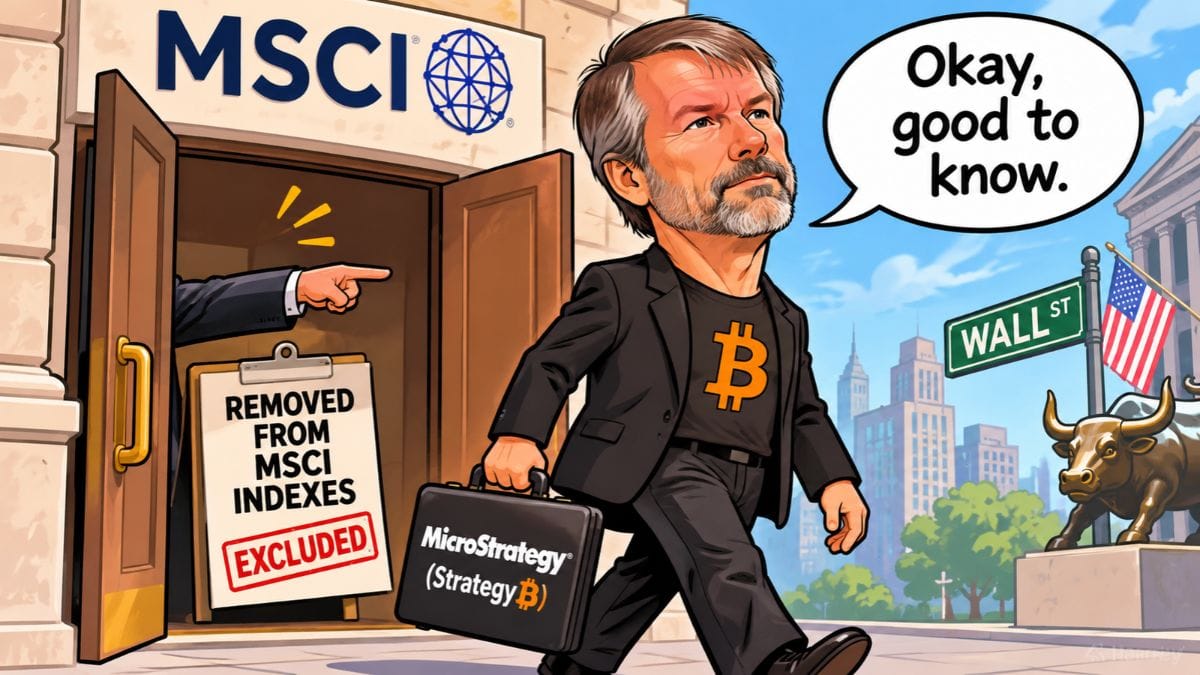
MSCI released its November 2026 Index Review on Nov. 11. Strategy’s Class A shares appear on the deletion list, and Japan’s Metaplanet and Upexi were also flagged for removal. Funds that track the affected benchmarks will need to sell shares they no longer have to hold.
Key takeaways
- MSCI’s November 2026 index review lists Strategy’s Class A shares for deletion from the MSCI USA Index. The change takes effect after the close on Nov. 30, and the rebalanced indexes go live Dec. 1.
- Strategy estimates that funds tracking MSCI’s indexes hold about 13 million of its shares, roughly 3.1% of basic shares outstanding and about $1.6 billion at $122 a share.
- Strategy stays listed on Nasdaq, and the index change does not by itself require it to sell any Bitcoin.
- The bigger question is financing. A lower share price makes it more expensive to raise the capital that pays for Bitcoin purchases, preferred dividends and debt service.
Strategy closed near $122 on Nov. 11 and slipped about 2.6% after hours, to roughly $119 (CoinCentral). Bitcoin fell to about $74,000 on the news.
How we got here
- October 2025: MSCI opens a consultation on excluding companies whose digital-asset holdings are 50% or more of total assets.
- January 2026: MSCI decides not to apply that rule for the time being, keeps current index treatment, and says it will study non-operating companies more broadly .
- August–September 2026: MSCI consults on a broader “non-operating company” screen. Strategy’s chairman and CEO respond publicly, calling the approach flawed.
- Mid-October 2026: MSCI adopts the framework.
- Nov. 11, 2026: MSCI publishes the review results.
- Nov. 30 close / Dec. 1: Deletions take effect and rebalanced indexes go live.
Why MSCI says Strategy no longer fits
MSCI’s Global Investable Market Indexes are built to represent operating companies. Investment funds and business development companies are already excluded. The new rule extends that logic to companies that are legally corporations but behave like investment vehicles.
The screen has two steps. A company first goes through a core screen based on operating assets. Those that fail are then tested on five financial ratios, and failing four of the five makes a company ineligible. For existing index members, MSCI’s consultation proposed these thresholds:
Test | What it looks at | Flagged as non-operating when |
|---|---|---|
Operating asset intensity | How much of the balance sheet is tied to operations | Below 10% |
Expense intensity | Operating costs relative to assets | Below 5% |
Cash flow screen | Cash generated by the business | Below zero |
Fair value intensity | How much results depend on fair-value gains and losses | Above 5% |
Capital dependence | Reliance on raising capital to accumulate assets | Above 30% |
Source: MSCI consultation document
MSCI’s review materials gave no company-specific explanation, so which tests Strategy failed is not public. Strategy’s own numbers show why it is a textbook case for the screen:
- Bitcoin dominates the balance sheet. Strategy held 848,517 BTC worth about $68.9 billion on Oct. 23, against software revenue of $125.4 million in the third quarter. At Bitcoin’s recent price near $74,000, that holding is worth roughly $63 billion (our calculation).
- Bitcoin’s price drives reported results. Q3 operating income was $20.91 billion, almost entirely unrealized gains on Bitcoin recorded under fair-value accounting.
- Capital raising is large. Management says it has raised about $21 billion of equity capital this year
Strategy’s position. The company argues that “operating” and “non-operating” labels have no basis in U.S. GAAP or IFRS, and says its software business has about 1,500 employees and nearly $500 million in annual revenue.
How much selling to expect
- Strategy’s estimate: about 13 million shares, or roughly $1.6 billion at $122. In September, the company said that equaled about 60% of its 30-day average daily trading volume.
- J.P. Morgan’s scenario (November 2025): up to $2.8 billion of outflows if MSCI removes Strategy, and another $8.8 billion if other index providers follow, for a total of up to $11.6 billion. That note predates MSCI’s final decision and was based on a larger market value, so treat it as a scenario, not a forecast. In December 2025, the bank added that much of the risk looked already priced in.
- Active managers are not required to follow index changes, though J.P. Morgan said a removal would still be read as a negative signal.
Index funds often trade at the closing auction on the effective date, so the main test is likely the Nov. 30 close. Bitcoin’s direction that day will matter: a rising market can absorb more selling than a falling one (our analysis).
 Surya Rianto

The bigger issue: funding the Bitcoin strategy
Strategy buys Bitcoin with money raised from common stock, preferred stock and convertible notes. When the share price falls, the same dollar raise requires more new shares. As an illustration, raising $1 billion at $122 takes about 8.2 million shares, while at $90 it takes about 11.1 million (our arithmetic).
Dilution is already visible. Class A shares outstanding rose 14.3% in the third quarter to 402.3 million, and Strategy’s BTC Yield metric, which tracks Bitcoin per assumed diluted share, was down 3.7% for 2026 through Oct. 25.
Fixed obligations add pressure:
- Preferred dividends were $419.6 million in Q3, about 3.3 times software revenue.
- Bitcoin sales: Strategy has sold about $431.8 million of Bitcoin this year to fund preferred dividends and repurchases of its STRC preferred stock. In Q3 it sold 5,552 BTC for $348.6 million, below its cost basis, while buying 7,218 BTC.
- Cash cushion: Dollar reserves and cash totaled $5.07 billion on Oct. 25, which the company says covers about 3.4 years of dividends and interest. That fell to roughly $4.9 billion by Nov. 1 after STRC buybacks and dividends (). The reserve is designed for dividends and interest, not for buying more Bitcoin.
- Debt: Strategy has $6.71 billion of convertible notes outstanding.
- Leadership: Chief Financial Officer Andrew Kang announced his departure alongside the Q3 results
What could go right
- Bitcoin recovery. Strategy’s exposure cuts both ways. A $10,000 move in Bitcoin changes the market value of its holdings by about $8.5 billion (848,517 × $10,000, our calculation). That is a paper gain or loss, not cash flow.
- Preferred “digital credit” products. STRC moves to daily dividends on Nov. 1, with STRF, STRK and STRD following Jan. 1, 2027, after shareholders approved the change. But one independent review noted that new preferred sales had stalled while STRC traded below its $100 target, and every new preferred adds a fixed dividend. The model works only if the added assets outweigh the cost of funding.
- Software subscriptions. Subscription revenue grew 49% to $68.6 million, even though total revenue fell 3% to $125.4 million.
What to watch next
- The Nov. 30 close: actual index-related volume and price action.
- Bitcoin’s price, which drives both the value of Strategy’s holdings and its ability to raise capital.
- The Federal Reserve’s Dec. 8–9 meeting, with the rate decision due Dec. 9 (Federal Reserve calendar). Rate expectations are also weighing on other high-growth stocks; our NVDA vs. AMD analysis after the selloff shows how the same pressure affects AI chipmakers.
- STRC trading versus its $100 target, and whether preferred issuance resumes.
- Other index providers, and whether any follow MSCI.
- Strategy’s Form 10-Q for Q3, which had not been filed as of Nov. 2 according to one analysis. Check SEC EDGAR for the latest.
Bottom line
MSCI’s decision reduces one source of demand for Strategy’s shares. It does not delist the company or, by itself, force a Bitcoin sale. The more important question is whether Strategy can keep funding its dividends and Bitcoin purchases without heavy dilution if the shares stay under pressure. Investors who see the lower price as an opportunity should weigh dilution, Bitcoin’s volatility and the company’s fixed obligations. For many, watching the post-Nov. 30 market reaction and the Fed decision before acting may be a reasonable way to gather more information. This is not a recommendation to buy or sell.
Sources
- MSCI: Consultation on Eligibility of Non-Operating Companies and November 2026 Index Review notice
- Index review coverage: Yahoo Finance, CoinCentral, Coin Edition, Brave New Coin, Coin Gabbar, FXStreet
- Strategy’s response: Benzinga, CryptoNews
- MSCI’s January 2026 decision: The Block
- Q3 2026 results: The Block, Bitcoin Treasuries, The Defiant, SEC-API, Finsee
- J.P. Morgan outflow estimates: The Block, Decrypt, Tiger Brokers
- Federal Reserve: December 2026 calendar
- Recommended before publishing: link directly to Strategy’s Q3 2026 8-K and 10-Q on SEC EDGAR and to MSCI’s final methodology document.
Mikirduit US provides independent financial research and educational content. This article is not personalized investment advice, and investors should conduct their own research before making investment decisions.