AI Stocks Face a Fed Test: Which Names Are Most Exposed to Higher Rates?
The Fed’s next rate move could test the AI investment boom. We compare Microsoft, Alphabet, Meta, Oracle, CoreWeave, Nvidia, AMD, Arista, Super Micro, Dell and other AI-linked stocks to see which balance sheets are strongest—and which are most vulnerable if higher rates slow data-center spending.

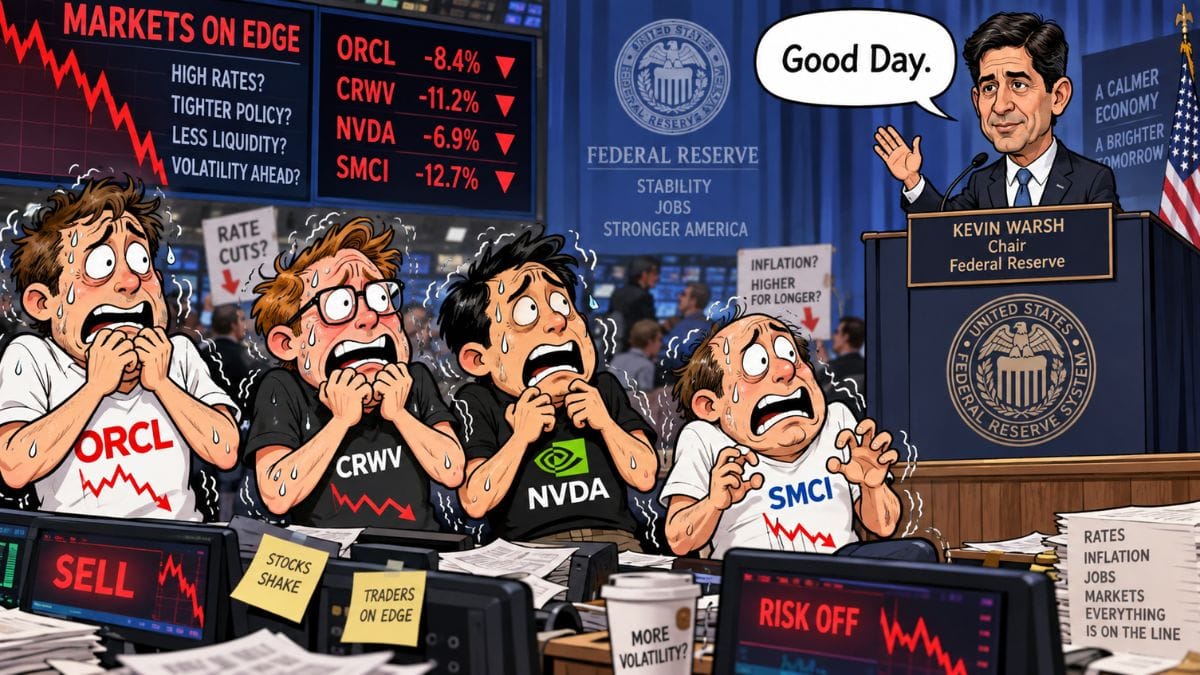
Mikirduit — Expectations are building that the Federal Reserve could raise interest rates on Sept. 16, 2026. For investors, the question is what another rate increase would mean for stocks tied to the artificial-intelligence investment boom.
3 Key Takeaways
- A single 25-basis-point Fed rate hike is unlikely to derail the AI investment cycle, but companies with high net debt, floating-rate exposure and heavy refinancing needs—such as CoreWeave and Oracle—face greater financial risk.
- Among AI infrastructure suppliers, Super Micro and Dell carry higher risk because rapid AI demand has pushed up inventory and working-capital needs, while AMD, Arista and Vertiv have stronger balance sheets and lower financing exposure.
- Nvidia remains one of the biggest beneficiaries of the AI boom, but with data-center revenue accounting for more than 90% of sales, its earnings are also highly sensitive to any slowdown in hyperscaler AI capital spending.
The risks fall into two broad categories.
The first includes technology companies spending heavily to build AI infrastructure, from data centers to computing capacity. The second includes suppliers benefiting from that spending through sales of chips, servers, networking equipment and power-and-cooling systems.
Higher rates can affect both groups, but through different channels.
For companies funding aggressive AI expansion, higher borrowing costs can make new debt more expensive. There is also a broader macroeconomic risk: if tighter monetary policy slows economic activity, some of the computing capacity being built today may take longer to monetize.
For suppliers, the risk is more indirect. If large technology companies slow their AI capital spending, vendors that have benefited from the boom could see orders delayed or revenue growth cool.
Still, a 25-basis-point Fed increase by itself would likely have only a modest direct effect. The bigger concern is for companies that rely on new borrowing, floating-rate debt or refinancing to support their expansion.
So which AI-related stocks appear most vulnerable—and which have the balance sheets to absorb higher rates?
The Companies Spending the Most on AI
Six publicly traded companies stand out for the scale of their AI-related expansion: Amazon.com Inc. (NASDAQ: AMZN), Alphabet Inc. (NASDAQ: GOOGL), Microsoft Corp. (NASDAQ: MSFT), Meta Platforms Inc. (NASDAQ: META), Oracle Corp. (NYSE: ORCL) and CoreWeave Inc. (NASDAQ: CRWV).
Among them, Amazon has the largest planned capital budget, at roughly $220 billion. Alphabet follows with an estimated $195 billion to $205 billion, while Microsoft is spending roughly $175 billion.
Debt levels, however, tell a different story.
Amazon carries about $133 billion of debt, the highest among the six. Oracle follows at about $125.3 billion, while Alphabet has roughly $101 billion.
To assess the risk from a 25-basis-point Fed increase, however, gross debt alone is not enough. Cash balances, net debt and the structure of the debt matter just as much.
Comparison of Major AI CapEx Spenders in 2026
| Stock | Planned / Run-Rate CapEx | Latest Debt | Cash + Securities | Net Debt / Cash | Sensitivity to +25 bps | AI Funding Risk |
|---|---|---|---|---|---|---|
| AMZN | ~US$220B in 2026 | ~US$133B face value of long-term debt | ~US$123B | ~US$10B net debt | Low direct impact | Low |
| GOOGL | US$195B–US$205B in 2026 | ~US$101B | US$242B | ~US$141B net cash | ~US$4.5M/year from current floating-rate exposure | Very Low |
| MSFT | ~US$175B in CY2026; FY2027 expected to rise YoY | ~US$46B principal | US$76.8B | ~US$31B net cash | Minimal | Very Low |
| META | US$130B–US$145B in 2026 | ~US$84B | US$90.3B | ~US$6B net cash | Almost no direct impact | Low |
| ORCL | US$28.5B in Q1 FY2027; very aggressive expansion | ~US$125.3B | ~US$37.1B | ~US$88B net debt | Minimal on existing fixed-rate debt, but refinancing risk is higher | High |
| CRWV | US$31B–US$35B in FY2026 | US$35.6B | ~US$5.5B | ~US$30B net debt | ~US$30.5M/year for every +25 bps on current floating-rate exposure | Very High |
Note: Interest-rate sensitivity is not calculated by simply applying a 25-basis-point increase to total debt. The impact depends primarily on floating-rate debt, refinancing needs and the cost of issuing new debt.
Microsoft, Alphabet and Meta Appear Better Positioned
Microsoft appears to be among the least vulnerable to a modest Fed increase.
The company has a strong liquidity position and most of its existing debt carries fixed interest rates, limiting the immediate effect of a higher federal-funds rate.
Microsoft is allocating roughly $116 billion toward shorter-lived computing hardware that must be refreshed more regularly, as well as cloud infrastructure and additional server racks to expand Microsoft Azure capacity.
About $25 billion of that amount reflects higher component costs, including more expensive RAM and storage.
Another roughly $58 billion is earmarked for data-center construction. Microsoft is targeting a sharp expansion in data-center capacity, aiming for roughly 38 gigawatts by 2032, compared with about 12 gigawatts currently.
Alphabet also appears relatively insulated.
The company has approximately $242 billion in cash and liquid securities against roughly $101 billion in debt, leaving it with about $141 billion in net cash.
Alphabet does have some floating-rate borrowings. A 25-basis-point increase in interest rates could raise annual interest expense by roughly $4.5 million, but that amount is immaterial relative to Alphabet's overall earnings and cash flow.
Alphabet's massive capital program is being directed toward data centers, computing hardware, Google Cloud expansion and infrastructure supporting its core products.
Meta ranks as another relatively well-protected company.
The company has roughly $84 billion in debt and about $90.3 billion in cash, leaving it with approximately $6 billion in net cash.
Most of Meta's existing debt is fixed-rate, which means a 25-basis-point Fed move would have little immediate impact on its interest expense.
The bigger issue would arise if Meta needed to issue additional bonds. New debt would likely carry higher yields than prior issuance.
 Surya Rianto
Oracle and CoreWeave Carry More Financial Risk
Oracle and CoreWeave stand out as the more exposed names if rates move higher.
Oracle has the second-largest debt load among the six companies analyzed. Its cash balance is only about $37.1 billion, while debt totals roughly $125.3 billion, leaving the company with approximately $88 billion in net debt.
That makes refinancing more important.
If Oracle needs to roll over existing obligations in a higher-rate environment, replacement debt could carry higher coupons and push interest expense upward.
Oracle is also relying on equity financing to support its expansion.
During the first quarter of fiscal 2027, the company had the capacity to sell as much as $20 billion of stock through an at-the-market offering. During 2026, Oracle had already raised roughly $43 billion in debt and $5 billion through equity issuance.
CoreWeave is the riskiest of the group.
The AI infrastructure company carries approximately $35.55 billion in debt, against just $5.52 billion in cash, leaving it with roughly $30 billion in net debt.
Shareholders' equity is only about $5 billion, implying a debt-to-equity ratio of roughly 7.1 times.
More important, a meaningful portion of CoreWeave's borrowings carries floating interest rates.
A 25-basis-point increase in benchmark rates could lift annual interest expense by roughly $30 million.
The larger danger emerges if high rates persist long enough to force the company to refinance debt at materially higher yields. That could push funding costs meaningfully higher at the same time CoreWeave continues to spend aggressively on AI infrastructure.
The Other Side of the AI Boom: Suppliers
The second group includes companies that are not necessarily spending hundreds of billions of dollars themselves, but are benefiting from the companies that are.
These businesses have enjoyed strong demand because hyperscalers and other technology companies are ordering vast amounts of AI hardware and infrastructure.
That looks attractive as long as the investment cycle continues.
The risk is that if AI developers come under financial pressure and postpone projects, suppliers can feel the slowdown quickly—especially those whose revenue is already heavily exposed to AI infrastructure spending.
We analyzed eight beneficiaries of the AI-capital-spending boom: Nvidia Corp. (NASDAQ: NVDA), Super Micro Computer Inc. (NASDAQ: SMCI), Broadcom Inc. (NASDAQ: AVGO), Marvell Technology Inc. (NASDAQ: MRVL), Advanced Micro Devices Inc. (NASDAQ: AMD), Dell Technologies Inc. (NYSE: DELL), Arista Networks Inc. (NYSE: ANET) and Vertiv Holdings Co. (NYSE: VRT).
Nvidia has the highest exposure. Data-center revenue accounts for roughly 92.5% of total sales.
Marvell generates about 79% of revenue from data centers, while Super Micro currently gets about 60% of sales from AI-related solutions and expects that figure could exceed 80% in the future.
Vertiv does not disclose a comparable percentage, but AI and data-center investment have become major drivers of its growth.
The question is which suppliers are financially resilient—and which could struggle if the Fed indirectly slows the AI buildout.
AI Infrastructure Stocks Most Exposed to Higher Fed Rates
| Stock | AI Exposure / Proxy | Debt Position | Net Debt / Cash | Leverage Needed to Capture AI Demand | Direct Impact of Fed +25 bps | Combined Risk |
|---|---|---|---|---|---|---|
| NVDA | Data Center = 92.5% of revenue | ~US$30B+ after new debt issuance | Large net cash position | Low | Almost none | High AI dependency, low leverage risk |
| SMCI | AI ~60% of Q4 revenue; >80% forward expectation | ~US$8.8B including convertible and bank debt | ~US$1.3B net debt | High | ~US$10M/year | High |
| AVGO | Direct AI semiconductor = 56% of revenue | US$61.1B principal | ~US$37B net debt | Low–Medium | Almost none on existing debt | Medium |
| MRVL | Data Center = ~79% of revenue | ~US$5.0B | ~US$1.1B net debt | Medium | Almost none | Medium-High due to AI dependency |
| AMD | Data Center = 58% of revenue | US$3.25B | ~US$9.9B net cash | Very Low | ~Zero | Low balance-sheet risk |
| DELL | AI servers = ~35% of Q2 revenue | US$34.7B | ~US$23B gross net debt | Medium-High, mainly working capital and DFS | Partly mitigated by hedging | Medium-High |
| ANET | AI fabrics target ~US$3.5B in FY2026 | Practically no material debt | US$13.3B cash + securities | Very Low | ~Zero | Low |
| VRT | AI and data-center demand are key growth drivers | US$2.94B | Net cash | Low | ~Zero | Low–Medium |
Note: The impact of a 25-basis-point Fed rate increase depends on more than total debt. Key factors include fixed- versus floating-rate exposure, refinancing needs, working-capital requirements and how dependent each company is on continued AI capital spending.
Arista Looks Relatively Defensive
Arista Networks appears to be one of the least vulnerable infrastructure suppliers.
Management expects AI-fabric revenue to reach roughly $3.5 billion for full-year 2026.
That is a meaningful number, but Arista remains diversified across cloud networking, AI networking, campus infrastructure and routing.
Its balance sheet is another advantage.
Arista holds roughly $13.34 billion in cash and marketable securities, including bonds that can be readily sold.
A 25-basis-point Fed increase would therefore have little direct financial impact.
The main risk is customer concentration and hyperscaler data-center spending. If customers postpone new infrastructure projects, Arista's revenue growth could temporarily slow.
But its balance sheet leaves it well positioned to absorb that volatility.
AMD Has More Supply-Chain Risk Than Interest-Rate Risk
AMD is another AI supplier that appears relatively protected from higher rates.
Its Data Center segment generated $6.72 billion in second-quarter 2026 revenue, equal to about 58.2% of companywide sales.
The segment's growth is aggressive, however, with revenue rising 107% year over year.
From a leverage perspective, AMD has little to worry about.
The company has roughly $13.11 billion in cash against only about $3.25 billion in debt, leaving it with approximately $9.86 billion in net cash.
Its major borrowings also carry fixed rates.
That means a Fed increase would not directly raise AMD's interest expense on existing debt.
The bigger constraints lie elsewhere.
First is TSMC capacity. AMD depends heavily on Taiwan Semiconductor Manufacturing Co. for production. If leading-edge wafer capacity becomes scarce as AMD competes with Nvidia, Apple, Broadcom and others, AMD could secure orders but still struggle to turn all of them into revenue on schedule. In the worst case, some demand could shift to Nvidia.
Second is CoWoS and advanced-packaging capacity. Even if AMD has enough processed wafers, limited packaging capacity can delay completed accelerator shipments and therefore delay revenue recognition.
Third is high-bandwidth-memory supply. AMD's AI accelerators depend on HBM supplied by companies such as SK Hynix, Samsung Electronics and Micron Technology. If HBM becomes scarce, AMD could be unable to ship finished GPUs even when compute chips are available.
Scarcity could also lift component prices, squeezing gross margins.
For AMD, the bottleneck is therefore more likely to be production execution than financing.
Vertiv's Balance Sheet Has Improved Sharply
Vertiv is another name whose risk profile has changed substantially.
The company once carried much heavier leverage, but its financial position is now stronger.
Vertiv has roughly $2.94 billion in debt and about $3.11 billion in cash, putting it technically in a modest net-cash position.
Its debt is also largely fixed-rate.
That reduces the immediate effect of a Fed increase.
AI and data-center demand remain important growth drivers for Vertiv, but the company is no longer relying on a heavily leveraged balance sheet to participate in that boom.
Super Micro Carries the Most Risk Among AI Infrastructure Suppliers
Super Micro Computer appears to carry the highest combined financial and operating risk in the supplier group.
About 60% of current revenue is tied to AI solutions, and management believes more than 80% of future sales could eventually be AI-related.
At the same time, higher costs for GPUs, CPUs, memory, server racks, networking equipment and liquid-cooling components have pushed working-capital requirements sharply higher.
Super Micro often needs to purchase components before a project is completed and revenue can be fully recognized. It also appears to carry inventory in anticipation of future deployments.
That has forced the company to rely more heavily on external financing.
Total debt has risen to roughly $8.8 billion, while cash stands at around $7.52 billion, leaving Super Micro with approximately $1.3 billion in net debt.
More importantly, about $4.05 billion of that debt carries floating interest rates.
A 25-basis-point Fed increase could therefore raise annual interest expense by roughly $10.1 million.
The bigger risk is systemic.
If tighter monetary policy leads customers to delay AI expansion, Super Micro could face slower revenue growth just as financing costs rise on its floating-rate borrowings and substantial inventory remains on the balance sheet.
That combination makes SMCI one of the more sensitive stocks to a meaningful slowdown in AI capital spending.
Marvell Is Highly Exposed to the AI Cycle
Marvell Technology also carries significant AI-cycle exposure, though its leverage is much more manageable.
Roughly 79% of Marvell's revenue comes from data centers.
With nearly four-fifths of sales tied to that market, the company has become highly dependent on continued AI and cloud infrastructure spending.
Marvell carries about $5 billion in debt against roughly $3.93 billion in cash, leaving approximately $1.07 billion in net debt.
Its funded debt is largely fixed-rate.
Marvell does have access to roughly $1.5 billion in floating-rate borrowing capacity, but that facility had not been drawn as of its second-quarter fiscal 2027 results.
That means a 25-basis-point Fed increase would have little immediate effect on current interest expense.
The larger risk is Marvell's revenue concentration.
If AI infrastructure projects are delayed, Marvell could feel the effect relatively quickly.
If a 25-basis-point Fed increase does not meaningfully slow AI investment, however, the direct financial impact on Marvell should remain limited.
Dell Has an Inventory Problem to Watch
Dell Technologies could also be meaningfully affected if higher rates slow the AI infrastructure cycle.
AI-related revenue still represents only part of the company.
Dell generated roughly $16.4 billion in AI-server revenue out of $47 billion in total quarterly sales for the reporting period ending in August 2026.
That represents roughly 35% of revenue.
Still, growth in AI-optimized servers has been explosive, reaching roughly 100%.
The bigger issue is inventory.
Dell has accumulated large quantities of GPUs, memory, networking equipment and server components to fulfill its AI backlog.
Inventory rose approximately 104% in six months.
If major customer projects are delayed, those inventories could become a significant burden.
Dell has about $34.75 billion in debt and $11.57 billion in cash, leaving roughly $23.2 billion in net debt.
Its debt structure is largely fixed-rate, which limits the immediate effect of a Fed increase.
But Dell has approximately $8.48 billion in short-term debt, with another roughly $5.35 billion due in fiscal 2027.
If the company needs to refinance those obligations in a higher-rate environment, funding costs could increase.
Dell therefore resembles Super Micro in some ways: both need substantial working capital to support the AI-server boom.
The difference is that Dell is much larger and has a more diversified business, making its overall risk lower than Super Micro's.
What About Nvidia?
Nvidia sits on both sides of the risk equation.
On one hand, its earnings are now deeply tied to the AI investment cycle.
Data-center sales account for roughly 92.5% of total revenue.
If hyperscale data-center construction or other AI-compute infrastructure projects are postponed, Nvidia could be among the companies most directly affected.
On the other hand, Nvidia has one of the strongest balance sheets in the group.
The company holds approximately $56.6 billion in cash and liquid securities, excluding another roughly $42.8 billion in marketable equity securities.
Nvidia recently issued about $25 billion in senior notes, but those borrowings are fixed-rate.
The company therefore continues to hold a substantial net-cash position.
Nvidia does, however, face some of the same working-capital pressures as Super Micro.
Its supply commitments include wafer capacity, HBM, advanced packaging, system inventory and reserved supply-chain capacity.
Those commitments require significant working capital.
Still, a 25-basis-point Fed increase by itself is unlikely to have a meaningful direct impact on Nvidia.
The real risk would emerge if higher rates cause hyperscalers to delay data-center construction or slow their AI-infrastructure budgets.
The Bottom Line
We believe a single 25-basis-point Fed rate increase is unlikely to materially derail current AI expansion plans.
The risk would rise substantially if the Fed were to continue tightening and cumulative increases reached 75 to 100 basis points over the next 12 months.
In that environment, refinancing costs would rise, AI infrastructure projects could face higher hurdle rates, and some data-center expansion could be delayed.
For investors with a more moderate risk profile who still want exposure to the AI investment cycle, companies with stronger balance sheets and less dependence on external financing appear better positioned.
That group includes Microsoft, Alphabet, Meta, Arista Networks, AMD and Vertiv.
If those stocks were to sell off sharply solely because of a Fed rate increase, gradual accumulation could become more attractive.
Their stronger balance sheets and more diversified business models could allow them to recover more quickly than companies whose revenue, working capital and financing needs are much more heavily tied to the AI capital-spending boom.
The numbers are only the beginning.
Every week, Mikirduit US breaks down earnings, valuations, catalysts, and risks across U.S. stocks—so you can see what the market may be missing.
Mikirduit US provides independent financial research and educational content. This article is not personalized investment advice, and investors should conduct their own research before making investment decisions.